Messages and text#
Messages are written apart from the events. In RPG Tsukuru GB you write what people say in Messages メッセージ on the editor menu, map by map, and an event shows a message by its number with the Message command (Events). A message is up to four lines of sixteen characters, in kana, capital letters and digits: the text has no kanji at all. Messages can also show names by number, a hero's or an item's, so that they follow the names as the player or you change them.
The message editor#
Messages opens on a list of where messages belong: the 25 maps, five to a page with their kinds, then the world map フィールド and the common messages よくつかう メッセージ, "messages often used".
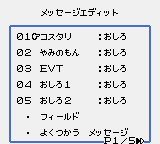
Each map has a block of messages of its own, numbered from 1, and an event can show only its own map's messages and the common ones. So write a person's lines under the map they stand in, and lines that many maps need (the inn's thanks, a locked door, the save fairy's offer) once, as common messages.
| Messages of | How many | Pages in the editor | Shown by |
|---|---|---|---|
| The world map フィールド | 60 | 10 of six | the world map's events |
| Each castle, town and village (maps 1–15) | 60 | 10 of six | that map's events |
| Each dungeon (maps 16–25) | 30 | 5 of six | that map's events |
| Common messages よくつかう メッセージ | 30 | 5 of six | every event, anywhere |
Choosing a map lists its messages six to a page, by number, with who speaks and the length. A on a number opens it for writing.
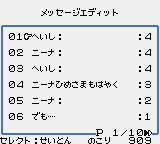
At the foot of the list, left のこり shows the room still free for messages, and SELECT tidies the list セレクト せいとん.
Writing a message#
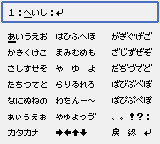
A message is typed on the keyboard every editor uses for names (Typing names): the hiragana in rows in the order of the kana table (あいうえお, かきくけこ …), with the voiced and half-voiced kana (が, ぱ …) in rows of their own; below them a row of the small kana and ゔ, with 、 。 ! ? ♥; and at the bottom カタカナ, which turns the board to katakana, and two arrows. Typing inserts until the field is full.
- Four lines of sixteen characters: 64 in all. Once the message is full, typing more overwrites the last character.
- A line may be ended early with a new line, or run on: a line of sixteen carries on at the start of the next.
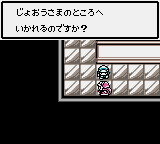
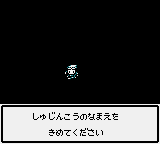
In play, a message comes up in a window across the foot of the screen, which has room for two lines, with a ▼ at its corner.
Names inside a message#
A message can hold a name by number instead of the name itself. The game puts in the name as it stands when the message is shown:
| Name of | Which | Shows |
|---|---|---|
| A hero | any of the 8 | the hero's name as it is now, after the player has named the hero |
| A spell | any of the 40 | the spell's name from the Magic editor |
| An item | any of the 115 | the item's name from the Items editor |
| A map | any of the 25 | the map's name from the map editor |
| A monster | any of the 72 | the monster's name from the Monsters editor |
So the sample's king says 「われら{map 1}おうけは」 ("we of the royal house of {map 1}"), and the player sees コスタリ, the castle's name in the map editor. If you rename the map, the line follows.
The hero's name is the one to use most. NOBLE CAT has the player name its hero at the start (Events), so every line that mentions him, 「{hero 1}、ひっかくわよ?」, shows whatever the player typed. A name typed into the message as letters would stay ロコ.
A name by number takes the room of two characters in the message's memory, and on screen as many as the name has.
The characters#
One font for everything: menus, the editors, messages, battles. Its characters are all the text can have:
| Kind | Characters |
|---|---|
| Hiragana | あ–ん with the voiced and half-voiced kana (が, ぱ …) and the small ones (ぁ, ゃ, っ …) |
| Katakana | ア–ン likewise, with ヴ |
| Letters | capitals A–Z only |
| Digits | 0–9, and the Roman numerals Ⅰ Ⅱ Ⅲ Ⅳ Ⅴ |
| Punctuation | 、 。 . , ・ … : ー 〜 ! ? 「 」 / + − % |
| Marks | → ← ↑ ↓, two pointing hands, ▼, ♥ ♪ ♫ ◆ ○, a skull, a drop of sweat |
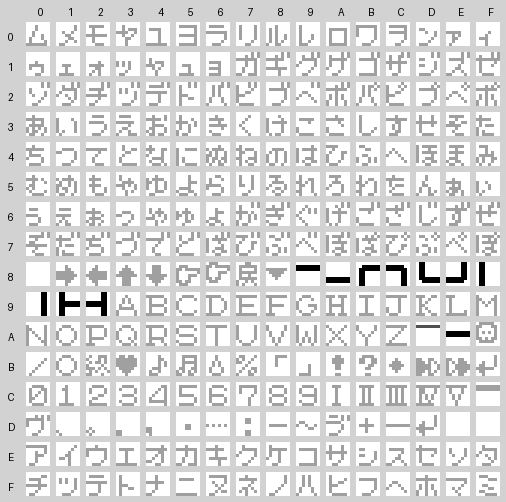
There are no kanji and no lower-case letters. A game in English is possible in capitals, as the sample's own title, NOBLE CAT, shows; but sixteen characters to a line is short for English.
The title font#
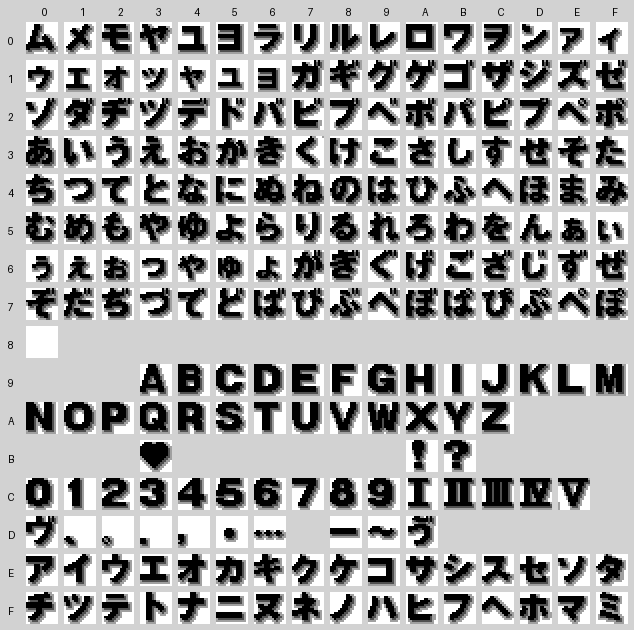
The game's title, two lines of eight, is the only text in a second, larger font: 16 × 16 with a drop shadow, shown on your game's title screen. It has the kana, A–Z, 0–9, Ⅰ–Ⅴ and a few marks.
Names and how long they can be#
The other texts of a game are names, typed on the same keyboard: the game's title, two lines of 8; your name あなたの なまえ, 16, shown second in the staff roll; a hero's, 5 (the player's too, with Enter name); a spell's, an item's, a monster's and a map's, 6 (Getting started).
Text the game writes itself#
Much of what the player reads is the program's own, and can't be changed: the command window and its pages, the shop's lines 「いらっしゃいませ!」 and 「ほかに ごようは ありますか?」, the inn's question 「ひとばん NG に なります / とまりますか?」 with your price in it, the save slots, every battle message (「かいしんの いちげき!!」, a critical hit), the Game Over and the staff roll.
To change how an inn or a shop speaks, build it from messages instead, as the sample builds its inns with a message, the yes/no question and a full recovery (Events).
Random message shows lines that are also the cartridge's: four for each character graphic, 249 in all, that you can't edit (Events).
What text can't do#
- No kanji, no lower case, no colours, no sizes but the title's.
- No numbers from the game: a message can show names, but not the party's gold, an amount, a level or a count. A price in a message is typed in by hand (the sample's inns say 「ひとばん 20Gになります」 in a message of their own).
- No choice but yes or no (Events).
- No message longer than four lines: a long speech is several messages in a row, each its own number, as the sample's opening tale of the demon world runs over nine.
Running out of room#
All the messages of a game share 12,457 bytes: every block, the world map's, the 25 maps' and the common ones. A message costs a byte for each character and each line break, two for each name by number, and one more to end it; an empty message costs one byte, so the blocks' empty places cost almost nothing. The editor's left のこり shows two bytes fewer than are free.
When it runs out, a message can't be begun or made longer: the editor buzzes and says 「のこりが たりません!」, "not enough left".
The sample nearly fills it. Its 356 messages with text, of the 1,290 places, take 11,546 bytes and leave 909. Its common messages are eleven lines it uses in many maps: the inn's lines, a locked door, a lever, the naming prompt, the save fairy.
Fan-made reference material, one of the Eschaton Games Tsukuru guides. Not affiliated with the publishers of the titles it covers. Corrections and questions: contact@eschaton.games.