Compared with Super Dante, RPG Tsukuru 2 and RPG Tsukuru 3#
This page is for a reader who knows one of the makers that came before RPG Tsukuru GB: RPG Tsukuru Super Dante (Super Famicom, 1995), RPG Tsukuru 2 (Super Famicom, 1996) or RPG Tsukuru 3 (PlayStation, 1997). It sets the four side by side, area by area, and says where a user of the older titles will find things on the cartridge. RPG Tsukuru 2 is "RT2" from here on and RPG Tsukuru 3 "RT3". Super Dante and RT2 have guides of their own (Super Dante, RT2), and this page links them where they help.
RPG Tsukuru GB is the same developer's maker, written again from nothing. Its own staff roll ends 「©2000 アスキー 空想科学」, Kuusou Kagaku, the studio behind the other three (Behind the scenes). But a Game Boy can't run a Super Famicom's or a PlayStation's code, and the cartridge carries none of it: what it inherits is a design, and one routine, the random number generator, kept to the last constant. The rest is a choice of what to keep from each. Super Dante gave it its scale and arrangement, RT2 its events, RT3 its taste for chance in battle; what 32 KiB of battery memory could not hold went into the ROM.
All four programs have been taken apart to the byte, in this study and the ones before it, so what follows compares what the programs do, not what their manuals say. There is no manual of RPG Tsukuru GB in the study.
How sure each line is#
Two programs that share no code can still share a rule, and that may be a memory of the older one or the same answer found twice. So each comparison here is marked by how it is known:
| Mark | What it means | Examples |
|---|---|---|
| Checked | Compared in this study against both titles' own data or code, not only their notes | The random numbers, the character codes, the order of the direction commands' routines, the inn, the sample games' names, the songs' melodies |
| From the notes | Each side is a decoded fact of its own title, set side by side here | Most rows: the database, the maps, the battle's rules, test play, storage |
| Inferred | A judgment of descent. Two programs that share no code (but one routine) may repeat a rule from memory or arrive at it afresh | Every "kept" on this page; the element letters A, B, C as an echo of RT3's attack classes |
Where a section below doesn't say otherwise, its facts are from the notes: each title's own decoded behaviour, set side by side. "Kept" always means the same rule, not the same code.
At a glance#
| Area | RPG Tsukuru GB (2000) | The titles before it | What GB did | Known by |
|---|---|---|---|---|
| The random numbers | The SFC titles' generator, also stepped while the program waits for the next frame | Super Dante and RT2: the same generator. RT3: the PlayStation's own | Kept, constant for constant, across a change of processor: the one routine GB carries over | Checked |
| The program | Native code; play and the editors run as 32 small cooperative tasks | Super Dante and RT2: every window, menu and editor page a script for one script machine. RT3: native code | Dropped the SFC script machine, as RT3 did | From the notes |
| Front end | Game, Edit, Link, Sample, Settings, Turbo File | Super Dante: Game, Edit, Turbo File. RT2 adds the memory pack and a Data page. RT3: GAME, EDIT, RETURN | Kept the Turbo File page; new: the link cable, the sample on the title, a cartridge that powers on into its own game | From the notes |
| The save | 32 KiB in sections, each with its own sum, checked when it is read. No signature: a silent format. A bad sum: a message, then a format | Super Dante: 32 KB, one sum, a message. RT2: 64 KB, nine sums, a silent format. RT3: compressed files on a memory card | Mixed the two SFC formats; new: sums checked section by section, as they are read | From the notes |
| Text | One byte a character: kana, capitals, digits, no kanji. Messages kept apart and shown by number | Super Dante: 16 kanji; RT2: 96. Both write a message inside its event. RT3: RT2's code, then Shift-JIS for the rest | Changed: a code of its own; no character sits at its RT2 code | Checked |
| Database | 8 heroes, 40 spells, 115 items, 72 monsters, 100 switches, a party of 3 | Super Dante: 8, 32, 128, 80, 200, 4. RT2: 12, 64, 127, 96, 240, 4. RT3: 16, 230, 250, 250, 500, 4 | Kept Super Dante's shape at about its size; smaller party and fewer switches than any | From the notes |
| Events | 4 pages, the conditions a switch, an item, the party, gold; 61 commands; no variables, no jumps | RT2: the same pages and conditions, 75 opcodes. Super Dante: 53 commands. RT3: 92 opcodes | Kept RT2's model and 55 of its commands; six new ones | Checked (the directions); from the notes |
| Maps | A floor is a grid of 5 × 5 or 6 × 6 rooms, each room a whole screen from the ROM | Super Dante and RT2: maps of 4 × 4 screens from a pool you build. RT3: cell by cell | Kept a map as a grid of screens; changed: the screens are fixed | From the notes |
| World map and vehicles | One of four fixed world maps; a ship and an airship | Super Dante: one of four fixed fields, a ship and an airship. RT2: a field you build, three vehicles. RT3: a flat map, the vehicles as items | Super Dante's arrangement exactly | From the notes |
| Encounters | 17 in 256 a step, at the latest on the 15th; a troop of six per area and per floor | Super Dante: a fixed curve. RT2: a rate per area and set groups | Kept Super Dante's fixed rate with a step counter, with numbers of its own | From the notes |
| Battle | Speed varied each round, a dodge, attack − defence ÷ 2, criticals, spells ± 5 %, four monster types | Super Dante: attack − defence ÷ 2. RT2: (attack − defence) ÷ 2, no rolls. RT3: random at every step | Kept Super Dante's damage rule; like RT3 in its randomness, with numbers of its own | From the notes |
| Play | Save from the menu anywhere on foot; one bag; an inn that revives and charges the whole gold | Super Dante and RT2: save only on the world map. RT2's inn takes its price from the low 16 bits of the gold | Changed: saving anywhere, an inn that cures everything, and RT2's inn bug gone | Checked (the inn) |
| Test play | START held walks through walls; SELECT: back to the editor, battles normal, quick or none, the switches | Super Dante: B for no battles and through walls. RT2 adds invincibility, a switch editor, the position. RT3: no walking through walls | Kept the walk-through, battles off and the switch editor; new: quick battles | From the notes |
| Sound | One driver, one code for songs and effects, lengths in frames, no tempo | Super Dante and RT2: one format with a tempo byte. RT3: Sony's sound library | Kept the model; changed every byte; no song shared | Checked (the melodies) |
| Storage | The Turbo File GB on the link port; the link cable | Super Dante and RT2: the SFC Turbo File Twin. RT3: memory cards | Kept the idea and the maker; new: the cable | From the notes |
| Sample game | NOBLE CAT | FATE; だんきちのバクチンだいさくせん!!; ゴブリくんの冒険 | Nothing carried over but generic names and one trick | Checked |
| Hidden content | An error screen, the soft reset, test play's extras; no development tag | Super Dante and RT2: the studio's tag, a reset combination, leftovers of their own | Kept an error screen and a reset; dropped the tag | From the notes |
One developer, a new program#
Super Dante and RT2 are one program grown: compared byte for byte, the two ROMs share about 47 KB of code, from the start-up to the event interpreter, and both carry the studio's development tag, KUSOU KAGAKU DEVELOPMENT SYSTEM, below the cartridge header (Super Dante's line). RT3 was written again for the PlayStation, but kept RT2's text code and event model, and Kuusou Kagaku's logo film opens it (RT2 against RT3).
RPG Tsukuru GB is that team's maker three years after RT3, and the cartridge says so twice: its developer's logo, 空想科学, comes up at every power-on, and its staff roll ends with 「©2000 アスキー 空想科学」. But its program is new. The Game Boy Color's processor, an 8-bit relative of the Z80, can run nothing of the Super Famicom's 65816 or the PlayStation's MIPS code, and the ROM has no development tag: no KUSOU, DEVELOPMENT or version string anywhere (checked). Its header names it RPGTCOOLGB, with ASCII's maker code.
Area by area#
The random numbers#
The generator is the SFC titles', constant for constant. Each new number is the last one times 5, plus 3711h, kept to 16 bits, and the high byte is what the game uses. RPG Tsukuru GB computes it the same way step for step: the number times 4, plus itself, plus 3711h (checked: both ROMs disassembled). It is the one routine the cartridge carries over, across a change of processor. RT3 uses the PlayStation's own generator instead.
Two habits came with it. RPG Tsukuru GB's main loop draws a number over and over while it waits for the next frame, as RT2's idle loop does (Super Dante, by every sign, draws none between battles), so the numbers depend on timing as well as on the player's buttons. And its start-up clears all of the working memory, so every power-on starts the generator from 0, where RT2's starts from whatever the memory held (How battles work, RT2's random numbers).
The program#
Super Dante and RT2 build every window, menu and editor page as a small program for one script machine, the same machine in both. RT3 dropped it and went back to native code, each screen a task of its own. RPG Tsukuru GB is native code too, with play and the editors run as up to 32 small tasks that take turns (How it works). On this point it is RT3's kind of program, not the SFC titles'.
Front end#
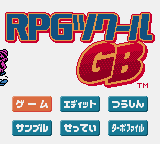
The title has six entries: Game ゲーム, Edit エディット, Link つうしん, Sample サンプル, Settings せってい and Turbo File ターボファイル. Super Dante's has Game, Edit and Turbo File; RT2 adds the memory pack and a Data page; RT3 has GAME, EDIT and RETURN.
- The Turbo File page is kept, for a different device (below).
- The sample is on the title, not under Game.
- Settings has one setting, the user-game mode ユーザーゲームモード: with it on, the cartridge powers on straight into the game made on it, a cartridge that has become its own game. None of the earlier titles has such a thing (Getting started).
- Link sends a game, part by part, to a second Game Boy Color: there was no cable on the Super Famicom.
The save#
RPG Tsukuru GB keeps one game in 32 KiB, Super Dante's size and half of RT2's. Its check borrows from both SFC titles and adds a step of its own:
- A save with no signature (a new cartridge, or one whose battery died) is formatted silently at power-on, as RT2 does.
- A save whose signature is there but one section's sum is wrong gets a message, 「カートリッジの データが こわれています。」 ("the cartridge's data is broken"), and then a format, as Super Dante's single sum does.
- The sums are checked lazily, a section at a time, when the game first reads that section. RT2 checks its nine at power-on; Super Dante its one.
Kept from both: the factory image of the sample in the ROM, played straight from there; three play slots, each tagged with the kind of game it belongs to (the user's game, the sample or test play). RT3 keeps compressed files on a memory card and shares none of this (Saving and sharing).
Text#
A code of its own, checked character by character against RT2's: not one character sits at its RT2 code. Hiragana start at 30h where RT2's start at 5Fh, katakana at E0h against 96h, digits at C0h against 30h. RT3 kept RT2's code; RPG Tsukuru GB didn't. The reason is plain once the code is read: each byte is the number of the font tile that draws it, so the code is the font's layout.
There are no kanji at all, where Super Dante has 16 and RT2 96, and the game writes everything in kana, capitals and digits. The only kanji on the cartridge are drawn as pictures: the developer's name in its logo and at the end of the staff roll, and the screen a monochrome Game Boy shows (Behind the scenes).
Messages are kept apart from the events, four lines of 16 characters each, and an event shows one by its number. Super Dante and RT2 type a message's text inside the command itself. Names go inside a message by number, a hero's, a spell's, an item's, a map's or a monster's (Messages and text).
Database#
| Super Dante (1995) | RPG Tsukuru 2 (1996) | RPG Tsukuru 3 (1997) | RPG Tsukuru GB (2000) | |
|---|---|---|---|---|
| Heroes | 8, with Magic Level on the hero's page; five stats, luck among them | 12; a stat is a base plus the level × a gain; the spell levels in the start settings | 16 characters and 16 jobs; a stat is (character + job) × the level + a base | 8; a stat is its gain × the level, with no base; HP 2 × stamina + 5, MP = wisdom; a learning level for each spell on the hero's page |
| Spells | 32, the effect fixed by the slot | 64, each choosing one of 20 effects | 230 with 36 effects | 40, the effect fixed by the slot; three elements, A, B and C |
| Items | 128 | 127 in 15 kinds | 250 in 11 kinds | 115, the kind fixed by the number; item 75 + n casts spell n |
| Monsters | 80 | 96 (32 field, 32 dungeon, 32 event); 13 battle methods and one unnamed | 250, with attack patterns of 8 slots | 72; four types; ten options and 40 spells as bits; the spells that work on it; one treasure with its odds |
| Switches | 200 | 240 | 500 | 100 |
| The party | 4 | 4 | 4 | 3 |
Super Dante's shape at about Super Dante's size. Eight heroes, each learning each spell at a level set on the hero's page (Super Dante's Magic Level, which RT2 moved to the start settings); spells whose effect is fixed by the slot rather than chosen (RT2 let each spell choose one of 20 effects). RPG Tsukuru GB goes one step further and fixes an item's kind by its number too: the cartridge spends no bytes on kinds or effects (The database).
- Dropped: a stat's separate base (a stat is simply its gain times the level) and luck. RT2's heroes and RT3's characters have both a base and a gain.
- The six hero presets are Super Dante's. The hero page's S button offers six classes, hero, warrior, mage, priest, sage and thief えいゆう, せんし, まほうつかい, そうりょ, けんじゃ, とうぞく, the very names and order of Super Dante's Type presets; like those, a class only fills in the gains.
- From RT2's monsters: the spells a monster uses and the spells that work on it, both kept as lists of on/off marks. RT2's unnamed fourteenth battle method, in which half the actions fail, comes back as an option any monster can take, half its attacks miss こうげき 2かいに 1かい ミス; RT3 had made it a monster flag, "Miss 1/2".
- Three spell elements, A, B and C, each all or nothing against a monster. RT3's attack classes are also called Magic A, B and C; the letters may be an echo (inferred), but RT3's work differently, by a cycle of quarter and one-and-a-half damage.
- Smaller than any of them: a party of three, and 100 switches.
Events#
RT2's page model, whole. An event has up to four pages; the game shows the last page whose conditions hold, page 4 first, page 1 the fallback, and a page with no condition set is never chosen. The conditions are RT2's four: a switch, an item carried, heroes in the party, gold at least so much. Super Dante has the same four (Events, RT2's pages).
What is smaller: the party condition is a mask of 8 heroes, not RT2's 16; a page's header is a fixed 10 bytes; 61 commands, all of fixed length, against RT2's 75 opcodes. There are no variables and no jumps: the yes/no question is the only branch. Chests are a kind of event of their own.
Command by command, against each title's list (from the notes):
- 55 of the 61 have an RT2 counterpart, 46 of them with the same arguments; 52 have a Super Dante one (all of Super Dante's 53 but paralysis); 55 an RT3 one, most only similar, since RT3 takes directions and colours as arguments.
- New in RPG Tsukuru GB: the random message ランダムメッセージ, a line chosen at random from four built in for the speaker's graphic; entering a hero's name なまえを いれる; the party's full recovery パーティの ぜんかいふく; the party's spin パーティ かいてん; the Game Over as a command ゲームオーバー; and the chest's own three-command script, which the editor never offers. The party's blink パーティ てんめつ is new against the SFC titles (RT3 has one).
- Dropped from RT2: paralysis, the caption, the mosaic, five screen tints and two blacks, the step styles that keep the facing or don't tread, a shop's places 5–8, a fourth monster in a battle.
- Kept from RT2: the wait in tenths of a second; the HP loss that stops at 1; and the encoding, one command for each direction and each tint, where RT3 folds them into arguments. From Super Dante: six movement types (RT2 has eight) and shops of four items.
- Changed: adding a hero to a full party. RT2 skips a fifth member; RPG Tsukuru GB overwrites the third place.
One detail shows the old design under the new numbers (checked). RPG Tsukuru GB numbers its direction commands up, down, right, left; RT2 and Super Dante number theirs up, right, down, left. But the routines that carry them out lie in the ROM in RT2's order, up, right, down, left, in the play code and the editor's alike. Only the numbers were changed.
Maps#
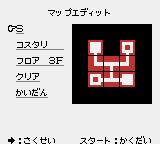
The SFC map, with its screens fixed. In Super Dante and RT2 a map is a grid of 4 × 4 screens drawn from a pool of screens the user builds (255 in Super Dante, 300 in RT2), each screen of parts and each part of chips. RPG Tsukuru GB keeps the idea of a map as a grid of screens, but each screen, a room, comes whole from the ROM: 1,054 prefabricated rooms, walls and passability included. A floor is a plan of 5 × 5 or 6 × 6 room types, so a castle floor costs 25 bytes of the save. A map is a building of floors joined by stairs (Maps and the world).
RT3 and its English version paint every map cell by cell from a tile set, the opposite answer. RPG Tsukuru GB's is the cartridge's answer to a save of 32 KiB.
World map and vehicles#
Super Dante's arrangement exactly: one of four fixed world maps in the ROM, chosen, not drawn, and walked on, with a ship and an airship. Super Dante's four fields are drawn in mode 7 (Super Dante's field); RPG Tsukuru GB's are flat tile maps that scroll. RT2's field is built by the user from island parts and has three vehicles; RT3's world map is a flat map crossed with a cursor, its ship and airship items.
Encounters#
Super Dante's fixed rate with a step counter, with numbers of its own: 17 chances in 256 each step, and a battle at the latest on the 15th step since the last. Super Dante has a curve from 0 to 4 in 256, then 1 in 8 from the 16th step; RT2 lets each area set a rate. Troops by place, as RT2's enemy maps: a troop of six monsters for each of the world map's 40 areas and for each floor, from which a battle takes one to three, fewer with fewer heroes (How battles work).
Battle#
| Super Dante | RPG Tsukuru 2 | RPG Tsukuru GB | |
|---|---|---|---|
| Turn order | By speed, fixed | By speed, fixed | By speed, varied by about 1/16 each round, in a sort that can swap equals |
| Hit | Always | Always | A dodge roll on the two speeds (1 in 4 between equals) |
| Damage | attack − defence ÷ 2; 0 is possible | (attack − defence) ÷ 2, at least 1 | attack − defence ÷ 2, on the varied stats; 0 or less gives 0 or 1 |
| Critical hit | defence ÷ 4 | 1 in 16; attack − defence | 1 in 16, or 1 in 4 for every monster's attack in the rest of a round once a monster with more criticals has attacked; defence ÷ 8; a critical can't be dodged |
| Spells | Fixed points | Fixed points | Points ± 5 %; a buff halves with each cast |
| How monsters choose | Equal odds | Equal odds over their options | Four types, each a list of priorities with rolls; the heroes' Auto plays the clever type |
| Escape | Tests on the speeds | Tests on the speeds' lowest, highest and average | The heroes' share of all the speed on the field |
| Poison | None in battle | 2 HP on the poisoned one's turn | Max HP ÷ 16 at the end of each round |
| Rewards | No chest | Every hero gets all the experience; the last kill's chest | Experience shared among the living; every kill can drop its treasure |
| Levels | The same table as RT2's | 10, 25, 47, 80 … experience; the gains added exactly | 10, 25, 45, 70 …; a random part in each rise |
The damage rule is Super Dante's: only the defence is halved, so attack 50 against defence 40 does 50 − 20 = 30, where RT2 would do (50 − 40) ÷ 2 = 5. The experience table follows RT2's (and Super Dante's) for its first two steps, then parts from it.
Everything around that rule is like RT3: chance at every step (RT3 has 5 % misses, ± 10 % on damage, criticals that double), a drop from every monster rather than one chest, escape weighed on the two sides' speeds. But the numbers are RPG Tsukuru GB's own: about 1/16 of variation, a critical that divides the defence by 8, an escape chance of the heroes' speed over all the speed. RT3's monsters follow weighted patterns; RPG Tsukuru GB's follow one of four types タイプ, each a list of priorities with rolls, and the heroes' Auto オート plays the clever one (How battles work).
Play#
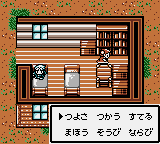
The command window is Status, Magic, Use, Equip, Discard and Order つよさ, まほう, つかう, そうび, すてる, ならび. Order is Super Dante's (RT2 has Settings in its place); one bag for the party is RT2's (Super Dante gives each hero ten items), with up to 99 of each item. There is no Talk and no Search: A does both (Playing a game).
- Saving from the menu anywhere on foot, inside maps too. Super Dante and RT2 save only on the world map.
- The inn cures everything and revives: HP and MP full, every status cleared, the dead brought back. RT2's inn leaves statuses as they are.
- RT2's inn bug is gone (checked). RT2 takes the inn's price from the low 16 bits of the gold only, so a party with 70,400 G at a 5,000 G inn came out with 130,936 G (RT2's bugs). RPG Tsukuru GB takes it from the whole amount.
Test play#
| Super Dante | RPG Tsukuru 2 | RPG Tsukuru 3 | RPG Tsukuru GB | |
|---|---|---|---|---|
| Walk through walls | B held | B held | No | START held, at a step a frame |
| No battles | B held | Monsters off | Battle off | Battles: none |
| A switch editor | No | Yes | Yes (500 switches) | Yes: 1–100 in a grid |
| Invincibility | No | Yes | Yes | No |
| The party's position | No | Yes | — | No |
| Battles won at once | No | No | No | Yes: quick battles, for no experience |
| Back to the editor | L + R + START + SELECT, to the title | L + R + START + SELECT, to the title | — | From the menu, or A + B + SELECT + START |
Walking through walls is kept, which RT3 dropped, but moved from B to START, and it goes at a step a frame, about twice the speed. The switch editor and battles off are kept, in a menu on SELECT; invincibility and the position are not. New: quick battles かんい, each won the moment it starts, for no experience (Getting started, Behind the scenes).
Music and sound#
The model is the SFC titles'; no byte is. As on the Super Famicom, a sound effect takes a channel from the music while it plays and the music comes back at its next note; a track has a fixed voice; there are transposition, jumps, calls and counted loops; a rest is note 0 and the notes run from 1 to 5Fh, RT2's range with the top bit set. As in Super Dante, songs and effects share one code space. The rest is new:
- no command byte in common with RT2's driver;
- no tempo: a note's length is counted in frames, as if every song ran at RT2's tempo 150;
- pitch from a table of the sound chip's register values, not RT2's 1/32 semitones;
- 14 jingles that stop the song and start it again from its beginning.
No song is shared (checked). Every melodic line of RPG Tsukuru GB's 129 was set, as a run of intervals, against the 557 of Super Dante, RT2 and Kanadeeru: the longest match is 11 intervals of a stock figure. The same search, as its control, found that RT2's song 3 and Super Dante's song 3 are the same piece, every track from the first note. RT3 plays its music through Sony's sound library and shares nothing (Music and sound).
Storage#
The SFC titles save to the Turbo File Twin, ASCII's battery box for the Super Famicom (RT2 also to a memory pack); RT3 to memory cards. RPG Tsukuru GB keeps the idea and the maker on a new device, the Turbo File GB on the link port, which holds 30 games on the unit and 30 on its memory card, where a Twin held three Super Dante games or two of RT2's. The link cable is new: a game sent part by part, ten parts in all, to a second Game Boy Color (Saving and sharing).
Sample game#

Nothing carried over (checked: the heroes', spells', items' and monsters' names of the three samples in the ROMs compared). NOBLE CAT, credited to アスキー・ケイアイディア, has its own cast, ロコ, ニーナ, ねこニーナ and ガレー (Roko, Nina, Neko-Nina, Garē). Super Dante's FATE is Norse myth played straight; RT2's だんきちのバクチンだいさくせん!! a school comedy that teaches the manual; RT3's ゴブリくんの冒険, known in English as Gobli, a story of its own (The sample game).
Only generic names recur (スライム, ゴーレム, ゾンビ, ミミック, やくそう, ロングソード among Super Dante's; ゴーレム among RT2's), and one trick: a blank hero named とうめい ("invisible"), kept to empty a place in the party. RT2's sample has one, and so does NOBLE CAT; Super Dante's FATE has an invisible hero too, spelt とーめい.
Hidden content#
Super Dante and RT2 carry the studio's development tag, and use it to tell a reset from a power-on. RPG Tsukuru GB has no tag. What it keeps: an error screen for the program's own faults (Super Dante has an older build's), and a soft reset, A + B + SELECT + START, the Game Boy's usual combination where the SFC titles use L + R + START + SELECT. Its leftovers are its own (Behind the scenes).
For a user of the SFC titles#
Where things are, for someone who knows Super Dante or RT2. The names are the three guides' own.
| What you look for | Super Dante | RPG Tsukuru 2 | RPG Tsukuru GB |
|---|---|---|---|
| Test play | Edit → Test Play | Game → Start → User Game Test | Edit → Test Play テストプレイ (Getting started) |
| Playing the sample | Game → New Game → Sample Game | Game → Start → Sample Game | The title's Sample サンプル, played from the ROM |
| The sample in the editors | Each editor's R menu: Sample Load, that editor's part | The Data page: the whole sample | Edit → Sample Load サンプルロード, the whole sample; a page's S button, one record or a hero class (Getting started) |
| Clearing the game | Edit → Delete All | The Data page | Edit → Clear Data データのクリア, one part or all (Getting started) |
| The title and the author | Title Settings | Title Settings, with three credit lines | Edit → Title タイトル: the title, the background, the music and your name (The database) |
| The heroes' spell levels | The hero's page: Magic Level | The start settings | The hero's page: magic level まほうレベル (The database) |
| Hero presets | The hero's R menu: Type, six presets | — | The hero's S: the same six classes, and the sample's hero (The database) |
| The party, vehicles and music | The start settings | Hero Settings: vehicles, the party, the BGM slots | The Heroes list: Party Settings, Vehicle Settings, BGM Settings (The database) |
| Spell effects | Fixed by the spell's number | Chosen for each spell | Fixed by the slot, as Super Dante (The database) |
| Maps and events | One editor, Maps and Scenario, events inside it | Map Making and Event Making | Two entries, Maps マップ (floors of rooms) and Events イベント (Maps, Events) |
| Messages | Typed inside the message command | Typed inside the message command | A page of their own, Messages メッセージ, by map; an event shows one by number (Messages) |
| The field | Change Field: one of four | Built from island parts | Maps → Choose the World Map: one of four (Maps) |
| Enemies by place | Enemy Maps, per screen | Enemy maps | Enemy Map てきマップ: a troop of six per area and per floor (Maps) |
| A battle test | The enemy-map editor's R menu | In the enemy-map editor | The Enemy Map's troop page: Test テスト, with a test party at levels you set (Maps and the world) |
| Getting a game off the cartridge | Turbo File | Turbo File, memory pack | Turbo File ターボファイル (a Turbo File GB), or Link つうしん to a second Game Boy Color (Saving and sharing) |
| Back to the title | L + R + START + SELECT | L + R + START + SELECT | A + B + SELECT + START (Playing a game) |
What RPG Tsukuru GB has that the others don't#
- A cartridge that boots as its game, with the user-game mode on.
- Maps from prefabricated rooms, so a whole floor is a plan of a few dozen bytes.
- The link cable, a game given part by part to a friend's cartridge.
- Random messages: four lines of chatter built in for each character graphic.
- The S presets on a page: the sample's record of the same number, copied in one at a time.
- Saving anywhere on foot, and an inn that revives.
- Quick battles in test play.
What a Super Dante or RT2 user will miss#
- Kanji, every one of them.
- A map drawn by hand: the rooms are fixed, and so is the world map, as in Super Dante.
- RT2's caption, mosaic and paralysis commands, its eight-item shops and a fourth monster in a battle.
- More than 3 heroes in the party or 100 switches; more than 8 heroes (RT2).
- Spell effects of your own choosing (RT2), and luck (Super Dante).
- Battle backgrounds: RPG Tsukuru GB's monsters stand on a plain white field.
- Test play's invincibility; Talk and Search in the command window.
For RPG Tsukuru Advance#
The next title, RPG Tsukuru Advance for the Game Boy Advance, has not been taken apart yet. When it is, these are the first things to set against this cartridge:
| What to compare | In RPG Tsukuru GB | Where it is told |
|---|---|---|
| The Turbo File Advance | Speaks the Turbo File GB's protocol, according to the public description of the device; the GBA title's driver can be read against GB's | Saving and sharing, How it works |
| The random numbers | Whether s × 5 + 3711h survives a third processor | How battles work |
| Events | The four-page model, the 61 commands, an opcode for each direction (renumbered), the chest's own script | Events |
| Maps | Rooms from the ROM, or cells painted as on the PlayStation; four fixed world maps | Maps and the world |
| The battle | attack − defence ÷ 2, the variation of about 1/16, the four monster types, a drop from every kill | How battles work |
| Text | One byte a character, the byte the font's tile; kanji or not | Messages and text |
| The save | Sections with 8-bit sums and a six-byte signature, against the GBA cartridge's memory | How it works |
| The rest | The sample game and the S presets; the link cable's ten kinds; test play's Select menu | The sample game, Getting started |
Fan-made reference material, one of the Eschaton Games Tsukuru guides. Not affiliated with the publishers of the titles it covers. Corrections and questions: contact@eschaton.games.