Behind the scenes#
Who made RPG Tsukuru GB, the line it belongs to, what its makers left in the cartridge besides the program, the cartridge this study worked from, and how the study behind this guide was done.
The credits#
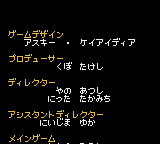
RPG Tsukuru GB names its makers in its own staff roll, and every game made with it ends with that roll: the event command that ends a game plays it, to a song of its own (Playing a game). Headings in yellow, names in white, scroll up the screen:
| On screen | In English | Names |
|---|---|---|
| ゲームデザイン | Game design | The made game's author, from its Title page (the sample's: アスキー ・ ケイアイディア) |
| プロデューサー | Producer | くぼ たけし (Kubo Takeshi) |
| ディレクター | Director | やの あつし (Yano Atsushi), にった たかみち (Nitta Takamichi) |
| アシスタントディレクター | Assistant director | にいじま ゆか (Niijima Yuka) |
| メインゲーム | Main game (program) | たむら ひろし (Tamura Hiroshi) |
| エディター | Editor (program) | ひびの さとし (Hibino Satoshi) |
| バトル | Battle (program) | もりぐち てつくに (Moriguchi Tetsukuni) |
| マップ | Map (graphics) | とよおか あつし (Toyooka Atsushi) |
| キャラクター | Characters (graphics) | いがらし ゆたか (Igarashi Yutaka) |
| サウンド | Sound | たけい ひろゆき (Takei Hiroyuki) |
| サンプルゲーム | Sample game | きむら はじめ (Kimura Hajime), ひろにわ やすたか (Hironiwa Yasutaka) |
| パッケージイラスト | Package illustration | やまのうち しん (Yamanouchi Shin) |
| マニュアルせいさく | Manual | やの あつし (Yano Atsushi), せんぼく はじめ (Senboku Hajime), やまもと ますみ (Yamamoto Masumi), まえとも ひであき (Maetomo Hideaki) |
| デバッグプレイ | Debug play (testing) | ちぐさ けいすけ (Chigusa Keisuke), せとい たくいち (Setoi Takuichi), ふじづめ ひろし (Fujizume Hiroshi), もり かずひろ (Mori Kazuhiro) |
| セールス | Sales | ごとう つよし (Gotō Tsuyoshi), おぐま たかひろ (Oguma Takahiro), のぐち まさき (Noguchi Masaki), ありじ つよし (Ariji Tsuyoshi) |
| プロモーション | Promotion | おさだ のぶひこ (Osada Nobuhiko), まゆずみ しんいち (Mayuzumi Shin'ichi) |
| スペシャルサンクス | Special thanks | Fourteen names, from おざわ たかゆき (Ozawa Takayuki) to ゆざわ あやこ (Yuzawa Ayako) |
| スペシャルサンクス | Special thanks | Eight companies and departments: くうそうかがく (Kuusou Kagaku), ケイアイディア, パセリプロモーション, アウトバック, ポールトゥウィン, アスキー (ASCII), デジタルファミつうへんしゅうぶ (the Digital Famitsu editorial department), しょうひんかいはつぶ (the product development department) |
| デベロップ マネージャー | Development manager | もり たかし (Mori Takashi) |
| スーパーバイザー | Supervisors | すぎうち けんじ (Sugiuchi Kenji), ふちがみ かずお (Fuchigami Kazuo) |
| エグゼクティブプロデューサー | Executive producer | はまむら ひろかず (Hamamura Hirokazu) |
| PRESENTED BY | Presented by | ASCII |
| (a picture) | Copyright | ©2000 アスキー 空想科学, then 「Fin」 |
The second line is yours. Under ゲームデザイン (game design), the roll shows the made game's author, the name typed as your name あなたの なまえ on the Title page, so every game made on the cartridge credits its maker first, above the program's own staff. The sample's line reads アスキー ・ ケイアイディア, the name its opening credits; ケイアイディア is thanked again near the end.
Three details of the roll as the ROM holds it:
- Five headings are cut short. The ROM has 「メインゲーム/プログラム」, 「エディター/プログラム」, 「バトル/プログラム」, 「マップ/グラフィック」 and 「キャラクター/グラフィック」 (main game, editor and battle programming; map and character graphics), but each record's length stops at the slash, so the roll shows only メインゲーム, エディター, バトル, マップ and キャラクター.
- A line nothing shows: 「くうそうさん」, just before the copyright's picture, after a stray end mark; no entry of the roll points at it. It may be the text the 空想科学 picture replaced (inferred).
- Only test play can skip it. In a game played from the title the roll runs to 「Fin」.
The developer#


RPG Tsukuru GB was published by ASCII アスキー in 2000. The cartridge is CGB-A2QJ, for the Game Boy Color only; its header calls it RPGTCOOLGB, with ASCII's maker code. At power-on three cards come up in turn before the title: the ASCII wordmark, the ASCII ツクールシリーズ ("Tsukuru series") badge, and the developer's logo, 空想科学, with its emblem.
Kuusou Kagaku 空想科学 ("fantasy science") is the studio that made Super Dante and RPG Tsukuru 2 on the Super Famicom and RPG Tsukuru 3 on the PlayStation. On the cartridges its name is a development tag in the ROM, KUSOU KAGAKU DEVELOPMENT SYSTEM; on RT3 a logo film. RPG Tsukuru GB has no tag: the name is in the logo at every power-on and again in the last line of the staff roll, 「©2000 アスキー 空想科学」, drawn as a picture rather than text. It is the same team's maker, three years after RT3, written from nothing for an 8-bit handheld: it shares no code with the older programs but their random number generator, constant for constant (Compared with the line).
The cartridge#
The study had RPG Tsukuru GB's ROM and the save of one second-hand cartridge.
- 2 MiB of ROM, 32 KiB of battery memory. The ROM holds the program, the pictures, 1,054 prefabricated rooms for the maps, the four world maps, one sound driver copied into four banks each with its own music, and, in its last two banks, the sample game as a whole save image: the very bytes the battery memory would hold, played straight from the ROM when Sample is chosen. Three banks are empty (How it works).
- The cartridge's save holds no game. It is the pattern a memory chip shows at power-on, never written. The game formats such a cartridge silently the first time it is switched on, so nothing on it could be lost. Every editor screenshot in this guide is of the sample, loaded with Sample Load サンプルロード, or of a save the study's tools wrote (Saving and sharing).
The sample, NOBLE CAT, credited to アスキー・ケイアイディア, carries two test-play saves at level 99 in its image, and a few leftovers of its making (below; The sample game).
Hidden content#
| What | How to reach it | More |
|---|---|---|
| Test play: START held walks through anything | Test play, START with the d-pad | below |
| Test play's menu: back to the editor, battles, switches | Test play, SELECT | below |
| An error screen: ERROR, TASKNO, JOBNO, PROCNO | Only on a fault inside the program | below |
| The staff roll, with headings cut short and a line it never shows | The event command that ends a game | above |
| A screen for a Game Boy that isn't a Color, with the game's only kanji text | A Game Boy or Game Boy Pocket | below |
| An unused title menu, and five more screens nothing shows | None | below |
| Four lines of chatter for each character graphic | The random message command | below |
| An older copy of the sample's common messages, and one message no event shows | None | below |
| A mode and a routine nothing uses; a Turbo File copy that was cut | None | below |
There is no debug menu. No sound test, map viewer or stats editor exists, and no flag unlocks one. The pad is read in one place only, and every one of its 362 reads was looked at: no code of buttons in sequence, and these combinations only.
| Buttons | When | What they do |
|---|---|---|
| SELECT held | At power-on | Turns the user-game mode off, so a cartridge that boots as its game shows the title again |
| A + B + SELECT + START | Any time but on the Link page | The soft reset: to the title, or from test play back to the editor |
| START + the d-pad | Test play | Walks through walls, sea and mountains, a step every frame |
| SELECT | Test play | Test play's menu |
| Any button | The staff roll, in test play only | Skips it |
Test play's extras#
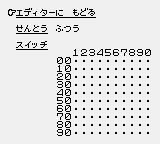
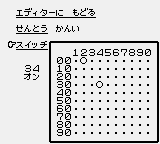
Test play has two tools that no screen of the cartridge mentions (Getting started):
- Hold START while walking and the party walks through walls, sea and mountains, a step every frame, about twice as far in the same time. Random battles still come. RT2 and Super Dante do the same on B.
- SELECT opens a menu with its own help lines, so it was meant for makers. Back to the editor エディターに もどる; battles せんとう: normal ふつう, quick かんい or none なし; and switches スイッチ, the maker's 1 to 100.
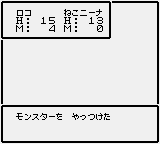
A quick battle is won the moment it starts: 「モンスターが あらわれた!」, 「モンスターを やっつけた」, and 「0の けいけんちを てにいれた」 (zero experience). Good for walking a route without fighting it; useless for levelling.
The error screen#
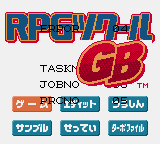
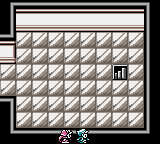
When the program meets a fault in itself, it stops on a screen of four numbers in hexadecimal, ERROR, TASKNO, JOBNO and PROCNO: the fault's code, the mode the program was in, the step within it, and the task that was running. They are drawn as sprites over whatever the screen held. It is a dead end: neither a button nor the soft reset leaves it.
| Code | Raised by |
|---|---|
| 0 | A set of tasks started with a bad count, and two other checks |
| 1 | All 32 task slots taken |
| 2 | Ending a task that doesn't exist |
| 4 | A division by zero |
Nothing in normal play reaches it. It was seen by setting the numbers by hand in the emulator. Super Dante has a crash screen too, from an older build of its program, which its final program never reaches.
On a Game Boy that isn't a Color#
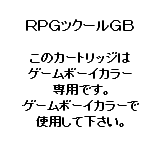
Put in a Game Boy or a Game Boy Pocket, the cartridge shows 「RPGツクールGB」 and 「このカートリッジは ゲームボーイカラー 専用です。」 ("This cartridge is for the Game Boy Color only. Please use it in a Game Boy Color."), and stops. The message is a picture, and it is the only kanji text in the game: the text font has none (Messages and text). The screen is drawn here from the ROM, not seen on a console.
Screens nothing shows#
The program's screens are stored as blocks of tiles, numbered. Six blocks are loaded by nothing:
| Screen | What it says |
|---|---|
| A title menu (shot below) | 「ゲーム / サンプル / エディット / つうしん」 as plain text: an earlier title menu, from before Settings and Turbo File (inferred) |
| 「マップエディット」 | A map-edit screen paged with 「←セレクト スタート→」, not the one the editor uses |
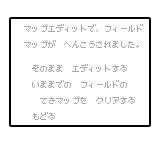
| An enemy-map warning (shot below) | 「マップエディットで、フィールドマップが へんこうされました。」 ("The world map was changed in map editing"), then: edit it as it is, clear the old world map's enemy map, or go back |
| 「あたらしいフロアが ついか されました。」 | "A new floor has been added." |
| 「のこり ようりょうが たりません」 | "Not enough space left": the editors say it another way, 「のこりが たりません!」 |
| 「なかみの マップを せっていしてください」 | "Please set the map inside." |
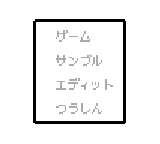
The released title has six picture buttons; the unused menu has four words, in another order, and neither Settings nor Turbo File. It looks like the title of an earlier stage of the program.
The random messages#
The random message command ランダムメッセージ picks one of four lines built in for the speaker's graphic: 280 lines for the 70 graphics, 249 of them different. Each character has its own chatter. The turtle says 「これはゼニガメだ!」; the samurai 「ワタシ ニホンジンデス!」; the demon lord laughs and chokes, 「ちょっとまってむせた💧」 ("wait, I choked"). One villager gives a fixed hint, to walk 50 east and 13 south and search, which can mean nothing on a map of yours. The ship, the airship and the markers all say 「・・・・・・・・・・・」 (Events).
Leftovers in the sample#
- An older copy of its common messages, past the end of the messages in the sample's image: an inn's lines since replaced by the program's own, doors and levers, nineteen empty messages, and last of all 「てすと」, "test". The editor never clears past the end, so this is what the sample's makers had before their last edits (inferred).
- Only one of its 356 messages is shown by no event: in map 10, ねこニーナ's 「ニャ〜!」, a line she says elsewhere anyway.
- Heroes 6 to 8 are named サンプル1 to サンプル3, placeholders no event uses; several maps have no events at all; and one map, named
EVT, is the stage for the sample's cut scenes (The sample game).
Unused code#
- A mode nothing enters. Its table sits just before the link cable's code, so it was most likely the Link page's own mode before that page became a part of the title (inferred).
- A routine nothing calls, after a return, with no call, jump or pointer to it.
- A Turbo File copy, cut. The Turbo File code keeps the messages of a copy between the device and its memory card, 「コピー しますか?」 and more, but nothing leads to them, and the menu has only Save, Load and Delete. A copy was planned and dropped (inferred; Saving and sharing).
- Three commands the editor never offers: they are a treasure chest's own script, built when a chest is opened (the lid and its sound, what was found, or 「なにもはいっていない。」 for an empty one).
- Sounds nothing plays: a few codes of the sound driver, among them pause and resume. Song 82h, which the editor doesn't offer, is the title screen's (Music and sound).
Beyond the header's RPGTCOOLGB and A2QJ there is no plain text in the ROM: no build date, no names, no version.
How this study was done#
Everything in this guide comes from the program itself. There is no manual or guidebook of RPG Tsukuru GB in the project, so the guide cites none.
- An emulator run headless. Mesen 2, its Game Boy core driven by a script with no window: button presses by script, saved states, memory watched, traced and dumped, screenshots from the emulated screen. Every run worked on a copy of a save.
- A code/data log. The emulator marks each byte of the ROM as code or data as it runs; runs over every screen marked 200,300 bytes of code, and a disassembler written for the study reads it. None of the SFC titles' tooling carried over: a new processor for the project.
- The editor as a probe. To learn what a byte means, a field was changed in a save, the editor's page read, and the code that reads it found. Every save was rebuilt byte for byte from its decoded form, and saves written by the study's tools were played.
- A picture processor of its own. A small model of the colour Game Boy's display draws a screen from the emulator's memory; rooms and the world map drawn from the ROM, and battle screens drawn from memory, match the emulator pixel for pixel.
- Battles replayed. Every random number a battle drew was recorded where the code drew it, and the battle replayed through a model of its rules written from the code: 39 battles, 743 turns, 11,238 draws, with no mismatch (How battles work).
- Sound rewritten and compared. The sound driver was rewritten in Python and checked against the game write for write to the sound chip, for every one of its 124 sounds; the study's synthesiser of that sound was compared, channel by channel, with SameBoy's.
- Two Game Boys and a Turbo File, modelled. Two copies of Mesen were linked through files to send every kind of data over the cable; a model of the Turbo File GB, written from the code and the public description of the device, stood behind the link port. No real Turbo File GB has been tried.
- The pictures and sounds of this guide come from the ROM by the study's tools: the graphics drawn from the game's own data, every song and effect played by the game's own driver, and the screenshots taken by script in SameBoy from power-on, with Mesen's colour adjustment. A few screens a script can't reach (a Turbo File, a second Game Boy, the error screen, the monochrome screen) are the analysis's own shots from Mesen.
The work ran as fourteen steps, each finished with its notes, a tool and a check:
| Step | What it settled | How it was checked |
|---|---|---|
| G1. The power-on check | What the game does with the save at power-on, and that the cartridge's save holds nothing | The silent format rebuilt byte for byte; the broken-data message on two damaged copies |
| G2. The program map | The main loop and its eleven modes, play's 32 tasks, the bank switch, a library of about 200 routines | A code/data log of 200,300 code bytes from runs over every screen |
| G3. The screens | Every menu and editor page, the sample in play, the world map and a battle | Screenshots from the emulated screen, with saved states to return to |
| G4. Text | The character code (the font's tile numbers), the two fonts, messages and names | Decoded text set against the screen |
| G5. The save | All 32 KiB in 24 regions, and the 400-byte play save | 72 saves rebuilt byte for byte; a save edited by tool played, then saved by the game to the same bytes |
| G6. The database | Heroes, the start settings, spells, items, monsters, the enemy map | Each field changed in a save and read on the editor's page |
| G7. Maps and graphics | Floors of prefabricated rooms, the four world maps, every picture | Rooms and the world map drawn from the ROM against the emulator's screen: 0 pixels differ |
| G8. Events | Pages, conditions, the 61 commands and their interpreter | Every event bank rebuilt byte for byte; an event written by tool ran as predicted |
| G9. Battle | The whole battle, and a dozen bugs in it | 39 recorded battles, 743 turns, 11,238 random draws replayed by a model with no mismatch |
| G10. Sound | The driver, its format, every song, jingle and effect | The driver rewritten in Python and checked write for write against the game, 124 sounds of 124; the synthesiser against SameBoy |
| G11. Link and Turbo File | The link's protocol and its ten kinds; the Turbo File GB's protocol and file | Two emulators linked, every kind sent; a modelled Turbo File GB, seven operations |
| G12. Play, limits, hidden content | Play as a runtime, every editor limit, test play's extras, unused content | The inn, quick battles, the walk-through and the error screen seen in the emulator |
| G13. Lineage | RPG Tsukuru GB against Super Dante, RT2 and RT3 | The random numbers, the text code, the commands, the inn, the samples and the melodies compared in the data |
| G14. Summary, second emulator | The overview, and a second emulator | The save, an event and nine battles run again in SameBoy, all agreeing |
A second emulator#
So that nothing rests on one emulator's quirks, the last step ran the save, an event and nine battles again in SameBoy, through a small frontend of the study's own. They agree:
| Check | What ran | In both emulators |
|---|---|---|
| The save | A play save written by the study's tool, loaded in test play and saved again by the game | The cartridge's memory the same byte for byte; three screenshots the same pixel for pixel |
| An event | An event written by the study's tool: gold, an item, a switch and a message | The same gold, switch and item; the same memory and screens |
| Nine battles | Battles recorded in Mesen, then run in SameBoy from power-on | Every lasting value of the battle in the same order, at most 3 frames apart; each recording replayed by the model |
| Two controls | Another battle's run; the same battle on the unchanged ROM | Both disagree, as they must |
On the way it found something about the game itself. The main loop draws random numbers while it waits for the next frame, as many as the time left allows, and the two emulators fit about one draw a frame more or less, drifting 396 steps further apart in 400 frames. From the same buttons they fight different battles. A console does the same, its numbers depending on its timing and the player's input; and since the start-up clears the memory, every power-on starts the generator from 0. For the comparison, a copy of the ROM with that one call removed made the numbers wait for the game, and the nine battles then agreed value for value. Two controls, another battle's run and the same battle on the unchanged ROM, disagree as they must.
What's left open#
RPG Tsukuru GB counts as decoded: every format a game is made of is read and written back. These points are not settled:
| Still open | Why |
|---|---|
| The battle's rarer paths: a surprise round, a confused hero, an instant kill, self-destruction, a monster's flight, items in battle, the curse's death | Read from the code and in the model, but never met in a recording: they need saves made to meet them |
| Stairs, room edges and entering a place from the world map; three spots in each place's record | Left to a later pass on the field |
| How an area's monster list is drawn from the enemy map | Not traced |
| The 35 animations and the object graphics, one by one | Cosmetic |
| Error code 0's own check, and one window | No normal path reaches either |
| A few text marks, and the name codes in battle text | Cosmetic |
| Timing to the cycle | Needs a real console: the two emulators part by about one idle draw a frame |
| A real Turbo File GB and a real link cable; the colour Game Boy's sound chip revisions | Needs hardware |
| Whether the manual tells of test play's START and SELECT | There is no manual in the study |
| The editors' deeper pages and the rarer battle screens | As screenshots only: their formats are decoded |
Fan-made reference material, one of the Eschaton Games Tsukuru guides. Not affiliated with the publishers of the titles it covers. Corrections and questions: contact@eschaton.games.