Events#
Everything that happens in a game is an event イベント: the people in the towns, the shopkeepers and innkeepers, the treasure chests, the locked doors, the signposts, the bosses waiting in their rooms, and every scene of the story. An event stands on one cell of a room (or of the world map), looks like a person, an object or nothing, and holds up to four pages of commands. Which page is in force is decided by switches, the items the party holds, who is in the party and how much gold it has. That is the whole of the game's logic: RPG Tsukuru GB has no variables and no jumps, and its only branch inside a page is a yes-or-no question.
Events are written in Events イベント on the editor menu. What they say is written apart, in Messages メッセージ, and an event shows a message by its number (Messages and text).
Placing an event#
The event editor lists the maps as the map editor does, with the world map フィールド; choose one, then a floor. The floor's plan of rooms comes up as in the map editor (Maps and the world), with left のこり, the bytes still free for events, at the bottom right. Pick a room, then a cell in it, and make the event there.
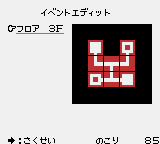
A room holds at most 7 people and 12 things. The editor counts them as you make events, and refuses one more:
| Kind | On screen | In a room | What counts |
|---|---|---|---|
| People | ひと | 7 | events whose page 1 has a character's graphic |
| Things | もの | 12 | everything else: objects and chests |
| Treasure | たから | within the 12 things | treasure chests; 250 in the whole game |
On the world map an event stands on any tile; there it is how the sample makes its signposts and the mouths of its caves. The world map's towns and castles are its places, which are kept with the events but aren't events (Maps and the world).
Pages#
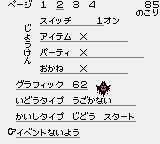
Each event has four pages ページ, and each page has the same fields:
| Field | On screen | What it sets |
|---|---|---|
| Page | ページ 1 2 3 4 | Which of the event's four pages you are looking at |
| Conditions | じょうけん | Pages 2–4 only: a switch on スイッチ オン, an item アイテム, the party パーティ, gold おかね (below) |
| Graphic | グラフィック | How the event looks: nothing, a character, or an object |
| Movement | いどうタイプ | How it moves by itself |
| Trigger | かいしタイプ | What starts its commands |
| Commands | イベントないよう | The list of commands the page runs |
Page 1 has no conditions: it is the event as it starts. Pages 2, 3 and 4 each have conditions, and a page whose conditions all hold takes over from the ones before it.
Which page runs#
The highest-numbered page whose conditions all hold is the one in force, page 4 first; if none of pages 2–4 holds, page 1. Each page has its own graphic, movement and trigger, so a page change can turn a closed door into an open one, a cat into a girl, or a boss into an empty floor.
A page among 2–4 with no condition set never runs. Setting a page's graphic and commands is not enough; it needs at least one condition. (The sample has one: a second page for its king in コスタリ, with no condition, which the game never reaches.)
Conditions#
A page can have any of four conditions, and all those set must hold:
| Condition | On screen | Holds when | Range |
|---|---|---|---|
| Switch | スイッチ オン | the switch is on | 1–100 (0: not used) |
| Item | アイテム | the party holds at least one of the item | any item, or none |
| Party | パーティ | every hero marked is in the party | up to three heroes |
| Gold | おかね | the party has at least that much | 0–999,999 (0: not used) |
- Switch: one of the game's 100 switches (below).
- Item: the party holds at least one. Combined with Item − in the page's commands, this is how a person takes a letter or a key from the player.
- Party: the heroes marked must all be in the party. At most three can be marked, since the party holds three: the editor refuses a fourth with 「パーティの じょうけんに くわえられるのは 3にん までです!」 ("you can add up to 3 people to a party condition").
- Gold: at least the amount. A page on gold can tell a player who can pay from one who can't, as the sample's inn does (below).
Graphic#
A page's graphic グラフィック is one of three things:
- Nothing: the event is invisible, and the party walks into it. The sample uses invisible events for scenes and for doorways that start a scene.
- A character: one of the 70 walking characters, the same as the heroes' graphics, the ships and the airships (The graphics catalogue).
- An object, drawn with the room's own tiles: a closed treasure chest (it shows open once taken), doors, signs and the like, and an invisible marker the sample uses where it wants an event that shows nothing. On the world map the places' icons are among them.


The 70 characters an event, a hero or a vehicle can wear.
Movement#
| Movement | On screen | What the event does |
|---|---|---|
| Still | うごかない | Stays where it is |
| Up and down | たてに おうふく | Walks up and down |
| Side to side | よこに おうふく | Walks from side to side |
| Random | ランダム | Wanders |
| Approaches | ちかよる | Comes towards the party |
| Flees | にげる | Keeps away from the party |
Trigger#
The trigger かいしタイプ says what starts the page's commands:
| Trigger | On screen | The commands run when |
|---|---|---|
| On touch | ふれた とき | the party walks into the event |
| A button | Aボタン | the player faces the event and presses A (across a counter too) |
| Automatic | じどう スタート | by themselves, with the party in the room |
People are usually A button; a shopkeeper behind a counter can be reached across it, since a counter's cells let the party talk over them (What blocks). Doorways and traps are On touch. Scenes are Automatic: they start by themselves when the party is in the room.
The commands#
61 commands, each of a fixed size. A page's list runs from top to bottom; there is no jump and no loop.
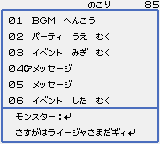
| Kind | Command | On screen | What it does | Bytes |
|---|---|---|---|---|
| Text | Message | メッセージ | Shows a message by its number: one of this map's own, or a common message (Messages and text) | 2 |
| Text | Random message | ランダムメッセージ | Shows one of four lines built into the cartridge for the event's graphic, chosen at random (below) | 1 |
| Text | Yes | はい | Asks yes or no. On yes the commands after it run, up to the matching No | 1 |
| Text | No | いいえ | Marks the end of the yes branch, where a yes ends the event. On no the event skips to the commands after it | 1 |
| Switches | Switch on | ゲームスイッチを ON | Turns one of the switches 1–100 on | 2 |
| Switches | Switch off | ゲームスイッチを OFF | Turns a switch off | 2 |
| Items and gold | Item + | アイテム ふえる | Gives one of an item (at most 99 of each) | 2 |
| Items and gold | Item − | アイテム へる | Takes one of an item away | 2 |
| Items and gold | Gold + | おかねが ふえる | Adds 0–999,999 gold; the purse stops at 999,999 | 4 |
| Items and gold | Gold − | おかねが へる | Takes gold away | 4 |
| Items and gold | Experience + | けいけんち ふえる | Gives 0–9,999,999 experience | 4 |
| The party's health | Party HP + | パーティの HP かいふく | Restores 0–999 HP to the party | 3 |
| The party's health | Party HP − | パーティの HP へる | Takes 0–999 HP from the party, never below 1: it can't kill | 3 |
| The party's health | Party MP + | パーティの MP かいふく | Restores 0–999 MP | 3 |
| The party's health | Party MP − | パーティの MP へる | Takes 0–999 MP | 3 |
| The party's health | Poison | パーティに どくを かける | Poisons the party | 1 |
| The party's health | Cure | パーティの どく・マヒを なおす | Cures the party of poison and paralysis | 1 |
| The party's health | Full recovery | パーティの ぜんかいふく | Fills every hero's HP and MP and clears every condition, death included: the inn's own cure | 1 |
| The party | Hero joins | なかまを くわえる | Puts a hero (1–8) in the next free place. Nothing happens if the hero is in already; with three in, the hero replaces the third | 2 |
| The party | Hero leaves | なかまを はずす | Takes a hero out of the party | 2 |
| The party | Enter name | なまえを いれる | Opens the keyboard for the player to name a hero (five characters) | 2 |
| Moving the party | Party faces up | パーティ うえ むく | Turns the party to face up | 1 |
| Moving the party | Party faces down | パーティ した むく | Turns it to face down | 1 |
| Moving the party | Party faces right | パーティ みぎ むく | Turns it to face right | 1 |
| Moving the party | Party faces left | パーティ ひだり むく | Turns it to face left | 1 |
| Moving the party | Party steps up | パーティ うえ いどう | Walks the party one cell up | 1 |
| Moving the party | Party steps down | パーティ した いどう | One cell down | 1 |
| Moving the party | Party steps right | パーティ みぎ いどう | One cell right | 1 |
| Moving the party | Party steps left | パーティ ひだり いどう | One cell left | 1 |
| Moving the party | Party spins | パーティ かいてん | Spins the party round, 0–99 times | 2 |
| Moving the party | Party blinks | パーティ てんめつ | Makes the party blink, 0–99 times | 2 |
| Moving the event | Event faces up | イベント うえ むく | Turns the event to face up | 1 |
| Moving the event | Event faces down | イベント した むく | Turns it to face down | 1 |
| Moving the event | Event faces right | イベント みぎ むく | Turns it to face right | 1 |
| Moving the event | Event faces left | イベント ひだり むく | Turns it to face left | 1 |
| Moving the event | Event steps up | イベント うえ いどう | Walks the event one cell up | 1 |
| Moving the event | Event steps down | イベント した いどう | One cell down | 1 |
| Moving the event | Event steps right | イベント みぎ いどう | One cell right | 1 |
| Moving the event | Event steps left | イベント ひだり いどう | One cell left | 1 |
| Moving the event | Event spins | イベント かいてん | Spins the event round, 0–99 times | 2 |
| Moving the event | Event blinks | イベント てんめつ | Makes the event blink, 0–99 times | 2 |
| Moving the event | Vanish | イベント きえる | Takes the event off the screen | 1 |
| Places and fights | Warp | ばしょ いどう | Moves the party to a map, its floor, room and cell, or to a cell of the world map. The event goes on after it | 5 |
| Places and fights | Battle | たたかう | A battle against up to three monsters (the same one may come twice), with the song to fight to | 5 |
| Shops and saving | Inn | やどや | An inn at a price of 0–9,999 gold a night: asks, takes the gold, and gives a full recovery | 3 |
| Shops and saving | Shop | おみせ | A shop selling up to four items, which also buys | 5 |
| Shops and saving | Save point | セーブ ポイント | Offers the three save slots. It doesn't heal | 1 |
| The screen | Brighter | がめん あかるくする | Brightens the screen | 1 |
| The screen | Darker | がめん くらくする | Darkens the screen | 1 |
| The screen | Red | がめん あかくする | Tints the screen red | 1 |
| The screen | Blue | がめん あおくする | Tints the screen blue | 1 |
| The screen | Monochrome | がめん モノクロにする | Takes the colour out of the screen | 1 |
| The screen | Normal | がめん もとにもどす | Puts the screen's colours back | 1 |
| The screen | Flash | がめん フラッシュ | Flashes the screen | 1 |
| The screen | Shake | がめん ゆらす | Shakes the screen | 1 |
| Sound and time | Wait | ウェイト | Waits 0–200 tenths of a second (up to 20 seconds) | 2 |
| Sound and time | BGM | BGM へんこう | Changes the music to one of the songs; song 0 is silence | 2 |
| Sound and time | Sound | おとを ならす | Plays one of the 94 jingles and effects | 2 |
| Endings | End of event | イベント しゅうりょう | Stops the event here | 1 |
| Endings | Game Over | ゲームオーバー | The Game Over, as when the party falls in battle: nothing is saved | 1 |
| Endings | Ending | エンディングに いく | Ends the game with the cartridge's staff roll, your name second | 1 |
The sample's 198 events use most of them. Its most used, by far, are messages (443), switches on and off (137), the party's steps (108), heroes joining and leaving (75), sounds (72) and warps (64).
Messages and the yes/no question#
Message メッセージ shows one message by its number: one of the map's own (60 for the world map, a castle, a town or a village, 30 for a dungeon) or one of the 30 common messages よくつかう メッセージ that every map can show. Each message is up to four lines of sixteen characters. Several messages in a row make a conversation (Messages and text).
The yes/no question is the only branch. Yes はい puts up the choice はい / いいえ under the message before it. The list then reads:
- Yes, then the commands for a yes;
- No いいえ, which ends the event for a yes;
- the commands for a no, to the end of the page.
Questions can sit inside the yes part of another question: the game matches each No to its own Yes. In the sample's town サッキス a young man admires the cat and asks 「ぼくにくれない?」 ("will you give it to me?"); yes gets a hiss from the cat, no a shrug.
Random messages#
Random message ランダムメッセージ needs no message of yours: the cartridge holds four lines for each of the 70 characters, 249 different lines in all, and the command shows one of the event's four at random. Each character has its own: the turtle says 「これはゼニガメだ!」, the demon lord starts a villain's laugh and chokes on it, and a villager gives directions (「ここから ひがしに50 / みなみに13あるいたところを / しらべてみて!」, "walk 50 east and 13 south and look") that can't mean anything in your world. The ships, airships and markers only say 「・・・・・・・・・・・」.
It costs a byte and no message, so it fills a town with chatter for nothing. The sample doesn't use it.
Switches#
There are 100 switches, numbered 1–100, each on or off. Switch on and Switch off set them, and a page's condition tests one. They are all the memory a game has: whether the king has spoken, whether the boss is beaten, whether the bridge is mended.
- In test play, SELECT → Switches shows all 100 as a 10 × 10 grid, and A turns one on or off (Playing a game): the quickest way to try a scene from the middle of the story.
- Treasure chests remember being opened by themselves, without using any of the 100 (below).
Items, gold and experience#
Item + and Item − give or take one of an item; nobody holds more than 99 of an item. Gold + and Gold − change the purse, which stops at 999,999 however much is added. Experience + gives up to 9,999,999 experience.
The sample marks a gift by writing the message itself, 「{item}をてにいれた!」 ("got the …"), with a jingle before it and Item + after: the command shows nothing by itself.
The party#
- Hero joins なかまを くわえる puts a hero in the next free place of the party. A hero already in isn't added twice. The party holds three: with three in, the new hero replaces the third, without a word.
- Hero leaves なかまを はずす takes a hero out.
- Enter name なまえを いれる lets the player name a hero, up to five characters, on the keyboard. There is no naming step of the game's own: if your hero is to be named, an event must ask. Messages that show the hero's name show the new one from then on (Messages and text).
- Party HP + and −, MP + and − change the whole party's figures by up to 999. HP − never kills: it stops at 1.
- Poison, Cure (poison and paralysis) and Full recovery act on the whole party. Full recovery is what the inn gives: HP and MP filled and every condition cleared, the dead raised too.
NOBLE CAT swaps heroes constantly: its heroine ニーナ (Nina) is cursed to turn into a cat at night, so every inn and every bed in the game takes ニーナ out and puts ねこニーナ (Neko-Nina) in, or the other way, with two switches saying which she is. Its fifth hero is named とうめい, "transparent", and the sample puts it in the party and takes it out again where it needs a place filled (inferred: what the blank hero is for isn't stated anywhere).
Moving the party and the event#
The party and the event itself each have their own commands to face and to step a cell up, down, right or left, to spin and to blink. Strung together, they stage the scenes: a guard steps aside, the party walks up to the throne, a villain blinks out. Steps follow one another, one cell each.
Vanish イベント きえる takes the event off the screen. The sample ends its bosses and its one-off scenes with it.
Warps and battles#
Warp ばしょ いどう moves the party to another place: any map, its floor, a room and a cell, or a cell of the world map. The page goes on after the warp, in the new place: the sample's inns warp the party to the room they are in, then heal it and give it the morning's lines; its scenes warp, then change the music.
Battle たたかう fights up to three monsters, which may repeat (the sample's パワロス comes back with his brothers: three of the same), and plays the song you choose for it: the sample's usual battle song , and for its last boss a song of its own. If the party falls, it is the Game Over, as in a random battle (in test play, the party is restored instead). If it wins, the page goes on with the commands after the battle.
Shops, inns and the save point#
- Shop おみせ sells up to four items, at the prices set in the item editor, and buys back the player's goods at half price, rounded up; an item priced 0 can't be sold. The player buys up to 9 at a time. A town with more goods has more shopkeepers: the sample's market town ハムズ has five.
- Inn やどや asks 「ひとばん NG に なります / とまりますか?」 ("that will be N G for the night; will you stay?"). On yes, with the gold, it takes the gold, fades out with a jingle , and gives a full recovery: dead heroes come back. Short of gold, it says so; on no it hopes to see the party again.
- Save point セーブ ポイント offers the three save slots. It doesn't heal. The player can also save from the command window anywhere on foot, so a save point is a courtesy; the sample has three, each a fairy セーブようせい who offers to save.
The screen#
Brighter, Darker, Red, Blue and Monochrome change the colour of the screen and leave it that way until Normal がめん もとにもどす puts it back. Flash and Shake are momentary. The sample darkens the screen for a night at the castle and puts it back in the morning, goes monochrome for the narration of its ending, and shakes the screen as each boss falls.
Sound and waiting#
BGM BGM へんこう changes the music to one of the songs; song 0 is silence. Sound おとを ならす plays one of the 94 jingles and effects, numbered as in the editor's list (Music and sound). Wait ウェイト counts tenths of a second, 0–200: 10 is one second, 200 twenty.
Ending the event and the game#
- End of event イベント しゅうりょう stops the page there. Useful after a yes branch's commands when more follow below.
- Game Over ゲームオーバー ends the game as a lost battle does: the Game Over screen and its song, and back to the title. Nothing is saved.
- Ending エンディングに いく ends the game with the cartridge's own staff roll, with your name second, under the game's design, and 「©2000 アスキー 空想科学」 and 「Fin」 last (). Your game has no ending screen of its own: its last scene, before this command, is its ending. After the roll, the player is back at the title, or at your game's own opening in the user-game mode.
Treasure chests#
A treasure chest is an event of its own kind, made as treasure たから. It has no pages: only an item (or none) and an amount of gold (0–999,999). The game draws it closed; when the party opens it, it plays a sound, gives what it holds and stays open from then on; an empty one says 「なにもはいっていない。」, "there's nothing inside".
- A game can have 250 chests, each with a number of its own; the editor keeps count. The sample has 32, which leaves 218.
- Each chest remembers being opened, apart from the 100 switches. Opening a chest uses up nothing else.
- A chest is one of the room's 12 things.
Switches and memory#
Besides the 100 switches and the chests, a game remembers nothing: no counters, no variables, no record of how many times a person was spoken to. What the player has done shows in the switches, the items held and the party, and those are exactly the four conditions, with gold. Plan the story as a chain of switches, each event's pages reading them.
Costs and limits#
Events are kept in a space of their own: 7,404 bytes for the whole game, of which one map's events may take 4,000 at most. The event editor shows what is left のこり; the sample leaves only 85. A full space refuses a new event with 「もう イベントを おけません!」 ("no more events can be placed") and a new command with 「のこりが たりません!」 ("not enough left").
| What | Limit |
|---|---|
| Events in a room | 7 people and 12 things |
| Treasure chests | 250 in the game (the sample has 32) |
| Pages | 4 an event |
| Room for one map's events | 4,000 bytes |
| Room for all the events | 7,404 bytes: the editor shows 6,848 left in a blank game, 85 in the sample |
| A new event | 13 bytes, a chest 17, before its commands |
| A command | 1–5 bytes (the table above) |
| Switches | 100 |
| A shop | 4 items |
| A battle | 3 monsters |
| A party | 3 heroes |
How NOBLE CAT does it#
The sample is the best manual there is. Load it with Sample Load and open these in the event editor.
The opening#
The game starts in the village アロン, in a room with one automatic, invisible event. It shows the common message 「しゅじんこうのなまえを / きめてください」 ("decide the hero's name"), runs Enter name for ロコ (Roko), warps the party to the castle コスタリ, changes the music, and swaps ロコ for ニーナ: the prologue is played as the princess.
A person whose pages follow the story#
トッド (Todd), in the town サッキス, wanders his room (Random, A button). Page 1 wonders why a letter hasn't come. Page 2, when the party holds the letter セラのテガミ, reads it in four messages, takes it with Item −, and turns switch 19 on. Page 3, on switch 19, has a single sad line. Three pages, two conditions, a small story.
Doors and locked doors#
A locked door in the tree ムシクイのき is two events side by side, each with three pages:
- A door object, A button: 「とびらにはカギがかかっている」, "the door is locked".
- When the party holds the key きのカギ: a sound, and switch 96 on.
- On switch 96: the invisible marker, on touch, with no commands. The door is gone and the way is open.
Doors that only open later in the story work the same way on a switch alone. The gate やみのもん has six such doors, each opened by the switch its boss's defeat turns on.
Caves and signposts on the world map#
A cave on the world map is an event with a cave's graphic, On touch: a sound and a warp into the dungeon. A signpost is an object, A button, with one message naming the towns in each direction.
A boss#
Each boss in やみのもん waits as a character with an automatic page 1: the party steps up to it, it steps forward, it speaks a message, then Battle against it (alone or with guards), Shake, a sound , and Switch on. Page 2, on that switch, has no graphic, On touch, no commands: the boss is gone for good, and the switch also opens that boss's door.
An inn with a story#
The innkeeper of サッキス has four pages. Page 1 is a plain Inn at 20 G, for the start of the game. Later pages build the inn by hand, so that the night can change ニーナ:
- Page 2, on switch 15: the inn's question as a message, Yes, then 「おかねが たりないようですね」 ("you seem short of money"), No, 「またの おこしを…」.
- Page 3, on switch 13 and at least 20 G: the same question; on yes the jingle , a Wait of one second, a warp to the same room, Full recovery, Gold − 20, ニーナ out and ねこニーナ in, switches 14 on and 13 off, and the cat's morning 「ニャ〜!」.
- Page 4, on switch 14 and at least 20 G: the same, the other way round.
The gold condition does the counting: with 20 G or more, page 3 or 4 holds and wins; with less, only page 2 holds, and it can only say no.
The ending#
The last boss stands in the map ラスボス. Its automatic page runs the confrontation, a Battle with the boss and two guards to a song of its own, then silence (BGM song 0), the boss's last words, Flash, ニーナ back in the party, Event blinks, and switch 66 on. Its page 2, on switch 66 and automatic, goes Monochrome, plays the ending's song, tells the epilogue in two messages, and warps to コスタリ, where another event's page on switch 66 takes over, and then to アロン, where a last one ends the tale (「ふたりはいつまでも / なかよくくらしましたとさ」, "and the two lived happily ever after"), goes Brighter, and runs Ending. One switch carries the ending across three maps.
Fan-made reference material, one of the Eschaton Games Tsukuru guides. Not affiliated with the publishers of the titles it covers. Corrections and questions: contact@eschaton.games.