Maps and the world#
A game made with RPG Tsukuru GB happens in two kinds of place. The world map フィールド is the outdoors: land and sea that scroll under the party, crossed on foot, by ship or by airship. Maps マップ are everything else: castles, towns, villages and dungeons, 25 of them. You build maps in Maps マップ on the editor menu, and choose the world map on the same page. Who stands where is the event editor's work (Events); which monsters lurk where is the Enemy Map てきマップ's (below).
Nothing here is drawn tile by tile. A map is a building of floors, a floor is a grid of rooms, and every room is a whole screen built into the cartridge, picked from a list. The world map is one of four, also built in. That is how a whole game fits in the cartridge's 32 KiB of save: a castle floor costs 25 bytes.
Rooms, floors and maps#
Maps are built in three steps, and you only ever choose the pieces.
- A room is one screen, 160 × 144 pixels: 10 × 9 cells of 16 × 16 pixels, the size of a person. The cartridge holds 1,054 rooms, drawn once and for all: a throne room, a stretch of town wall, a bedroom, a dungeon corridor. Each knows which of its cells can be walked on.
- A floor is a grid of places, 5 × 5 in a castle, town or village and 6 × 6 in a dungeon. Each place holds a room, or nothing.
- A map is a building of floors, up to 4, 2 or 7 depending on its kind, joined by stairs.
In play a room fills the screen and doesn't scroll. Walking off a room's edge takes the party into the room next to it on the plan, a screen at a time; walking off the edge of the map leads out to the world map (below). Positions inside a map (an event's place, a warp's destination) are a floor, a room and a cell of that room, x 0–9 across and y 0–8 down.
The 25 maps#
A map's kind is fixed by its number: maps 1–5 are castles, 6–10 towns, 11–15 villages and 16–25 dungeons. The kind decides how many floors the map may have, how big a floor is, and which rooms it can use.
| Maps | Kind | Floors | A floor | Room types to choose from | The sample's |
|---|---|---|---|---|---|
| 1–5 | Castle おしろ | up to 4 | 5 × 5 rooms | 180, the same on every floor | コスタリ, やみのもん, and EVT, a stage for scenes |
| 6–10 | Town まち | up to 2 | 5 × 5 rooms | 224 on 1F; 160 above it, 160 below | サッキス, ハムズ |
| 11–15 | Village むら | up to 2 | 5 × 5 rooms | 224 on 1F; 160 above it, 160 below | アロン, ガレーのいえ, シェロ |
| 16–25 | Dungeon ダンジョン | up to 7 | 6 × 6 rooms | 144 on 1F, 144 above it, 108 below; each dungeon in one of four looks | ちていつうろ, うみのみち, ムシクイのき, ひかりのとう, ラスボス |
Floors are named as in a building: 7F at the top, down through 1F, then B1 to B6 underground. A map's floors run one after another from its top floor down, as many as its kind allows: コスタリ is 3F, 2F, 1F and B1; the sample's spare castle おしろ2 is 1F, B1 and B2; the tower ひかりのとう is 6F down to 1F; the dungeon ダンジョン4 goes from 1F down to B4.
Which rooms a floor offers depends on where it is. A castle has one list of 180 rooms for every floor. A town, a village or a dungeon has three lists: one for its 1F, one for the floors above it and one for those below. A dungeon also has a look, one of four tile sets, chosen for the whole map (the graphics catalogue has the tile sets).
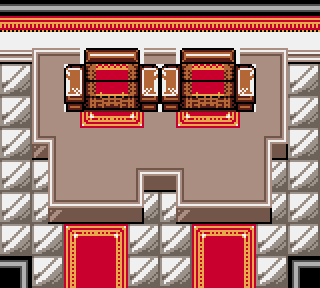
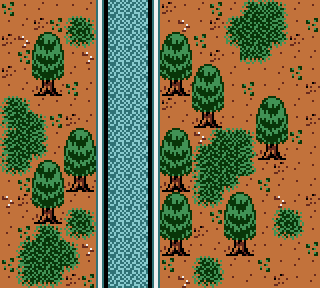
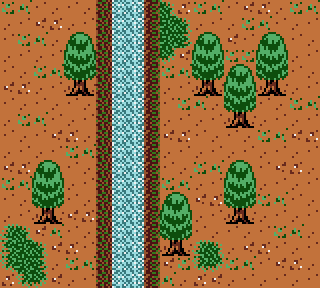
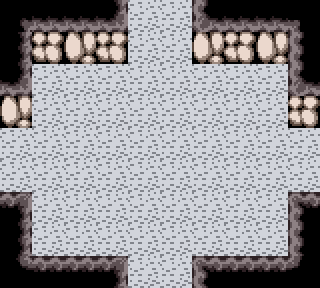
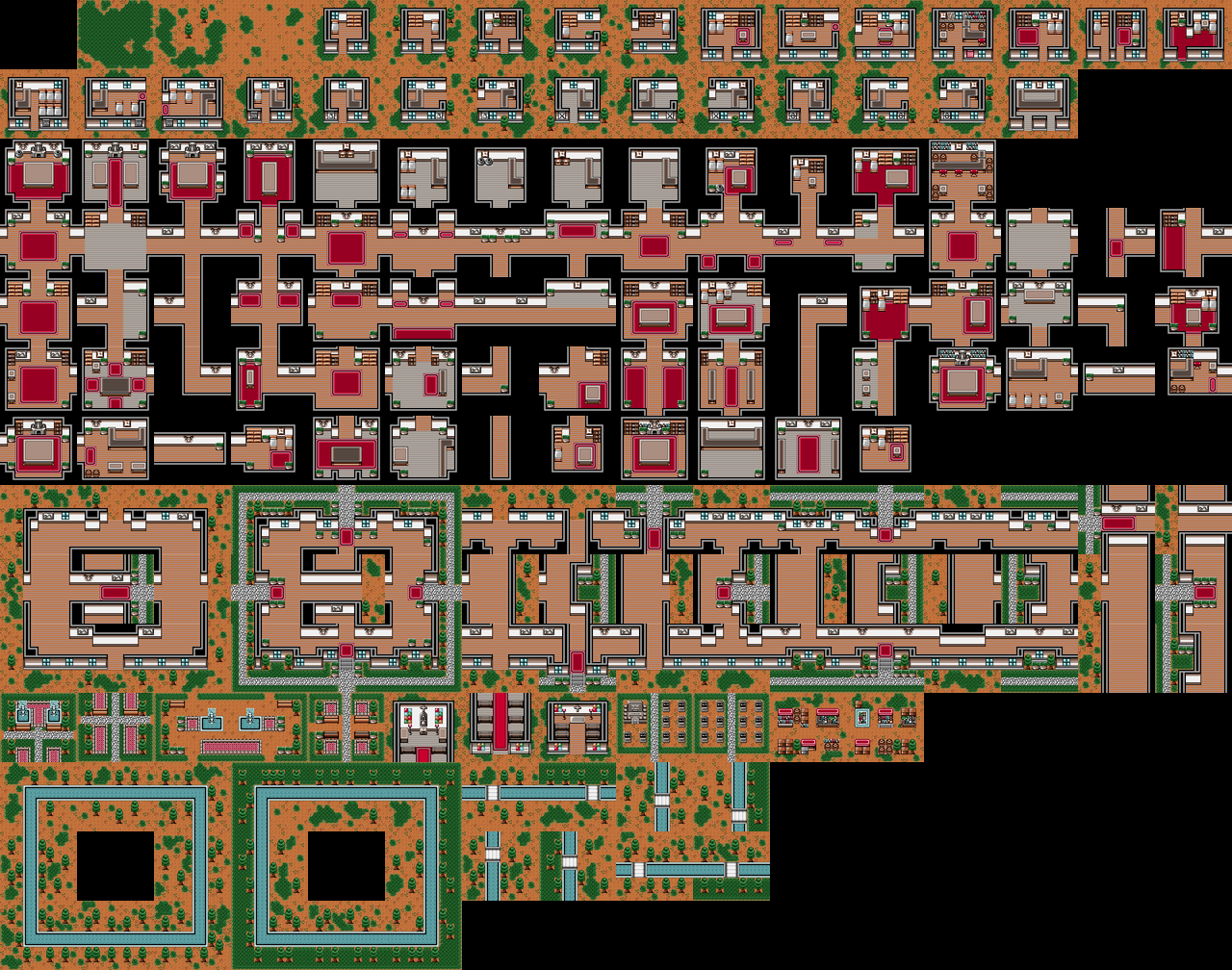
Each list can be seen whole in the catalogue's sheets, 16 rooms to a row:
What blocks#
Each room carries its own passability, a mark for each of its 10 × 9 cells. You don't set it: it comes with the room.
| A cell is | The party | Talking |
|---|---|---|
| Open floor | Walks on it | To whoever stands on the next cell |
| A counter, table or bed | Can't cross it | Across it: A reaches the person on the far side, as at a shop's counter |
| Wall, or anything else solid | Can't cross it | No |
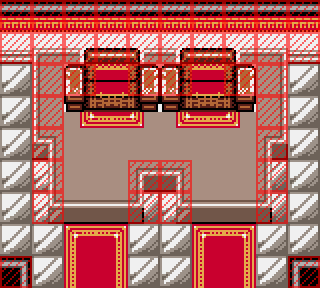
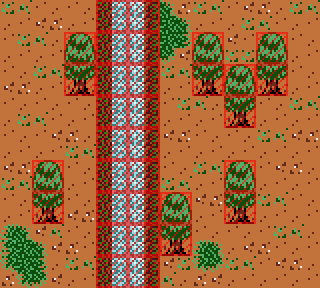
Events stand on cells too, and people block the way; whether an object blocks depends on the object (Events). In test play, holding START walks through anything (Playing a game).
The map editor#
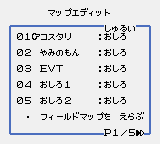
Choose Maps マップ on the editor menu. It opens on the list of the 25 maps, five to a page, each with its name and kind しゅるい: castle おしろ, town まち, village むら or dungeon ダンジョン. The last line of the list is Choose the World Map フィールドマップを えらぶ (below).
A on a map opens its page:
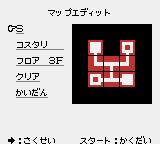 12345678
- 1 S S the sample presets: the sample's map of the same number, its name, floors and rooms
- 2 Name コスタリ the map's name, up to 6 characters
- 3 Floor フロア 3F the floor shown in the plan; the map's floors run from its top floor down
- 4 Clear クリア
- 5 Stairs かいだん the stairs between this floor and the next
- 6 Plan the floor's places, 5 × 5 here (6 × 6 in a dungeon); each lit square is a room. This is 3F, eight rooms
- 7 Make →:さくせい →: make
- 8 Zoom スタート:かくだい START: zoom
- Name: up to six characters, typed on the keyboard (Typing names). Messages can show it (Messages and text).
- Floor フロア: which floor the plan on the right shows. Changing it walks through the map's floors.
- Stairs かいだん: the stairs from this floor to the next (below).
- The plan shows the floor's places in miniature, a lit square for each room. → さくせい (make) and START かくだい (zoom) are offered at the foot of the page.
- A dungeon's page has one line more, type タイプ, for its look.
- S offers the sample's map of the same number, with its name, its floors and its rooms (The S button). It is a quick way to start: take the sample's コスタリ and change it.
Stairs#
Stairs join a floor to the one below it, up to three pairs for each two neighbouring floors. A pair of stairs is one spot on the floor plan, used by both floors: the upper floor shows stairs going down there, the lower floor stairs going up, at the same cell of the same room. The game draws the stairs over the room itself, from a block of tiles every room loads (stairs, doors and chests); you don't need a room with stairs in it.
Walking onto stairs takes the party to the other floor without any event: the sample's four-floor tree ムシクイのき has no event that moves between its floors. Since the two ends share a spot, put stairs where both floors have a room and an open cell.
Joining the maps to the world#
- From the world map into a map: the world map holds up to 25 places, each with an icon drawn on the ground and an entrance: a map, a floor, a room and a cell. Walking onto the place takes the party in. The places are kept with the events, apart from the maps themselves.
- From a map back out: walking off the outer edge of a map leads onto the world map, beside the place. The sample's first village, アロン, is left over a bridge and off its west edge.
- Anything else is an event with the Warp ばしょ いどう command (Events): a map, its floor, room and cell, or a cell of the world map. The sample's caves on the world map are such events, with a sound and a warp; so are its scenes that move the party from castle to village.
- The start of the game is a place too, set in Party Settings パーティの せってい (The database). NOBLE CAT starts in the village アロン.
The sample has ten places on its world map: the castles コスタリ and やみのもん, the towns サッキス and ハムズ, the villages アロン and シェロ, the house ガレーのいえ, and the dungeons ムシクイのき, ひかりのとう and うみのみち. Each enters its map on 1F.
Two spells move the party too (The database): teleport テレポート takes it from the world map to a place it has been to, and exit そとに でる takes it out of a map. The teleport's list names the places. (That it offers only the places visited is read from the program and inferred from how the places are marked, not seen.)
The world map#
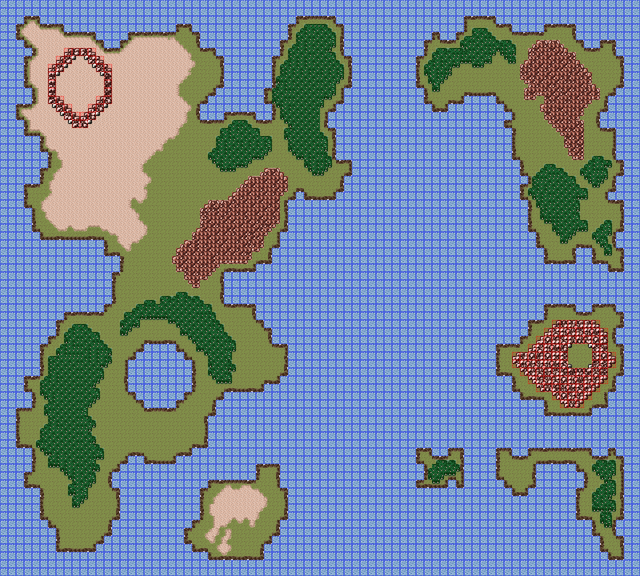
The world map is not drawn: you choose one of four, with Choose the World Map at the foot of the map list. Each is 160 × 144 tiles, eight screens across and eight down, with its continents, seas, forests, deserts and mountains fixed. It wraps round both ways: walking off one edge brings the party in at the other, so a ship can sail round the world.
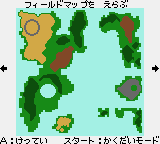
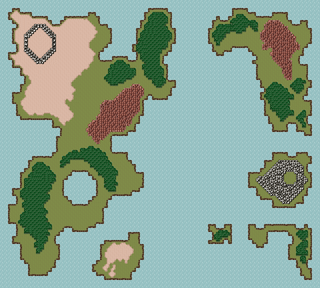
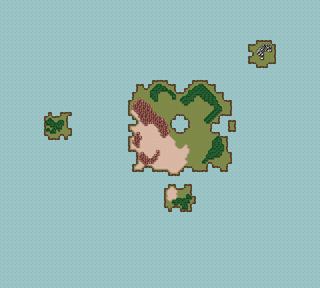
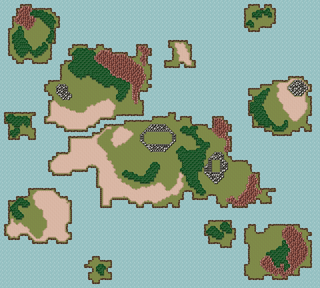
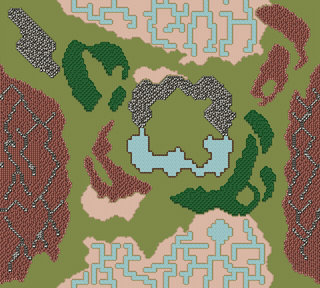
The catalogue has them at half size too (world_0.png … world_3.png), and the graphics catalogue shows them all.
Who goes where#
Every cell of the world map is walkable land, water or blocked, fixed with the world.
| Ground | On foot | Ship | Airship |
|---|---|---|---|
| Walkable land | Yes | No: A steps off onto it | Flies over; A lands on it, if no place or object stands there |
| Water | No | Yes | Flies over |
| Blocked (the mountains among it) | No | No | Flies over |
The ship and the airship are where Vehicle Settings のりものの せってい put them at the start (The database): each has a starting spot on the world map and one of four graphics. Walking onto one boards it, and its own song plays. The ship sails only water, at walking speed, and meets monsters; it can't enter a place, and A steps off onto land ahead. The airship flies anywhere, fast, and meets no monsters; it lands with A on open walkable ground with no place or object on it, so the party lands beside a town, not on it. In either, the command window has no Save (Playing a game).
Walking into blocked ground on foot gives a bump ; a refused landing or stepping-off a buzz .
The enemy map#
Random battles are set in Enemy Map てきマップ, apart from building the maps. The unit is the troop: six monsters, any of the 72, with places left empty as you like. Each area of the world map and each floor of each map has one troop.
| Where | Troops | The editor shows |
|---|---|---|
| The world map | 40 areas, a troop of six each; the areas' shapes belong to the world map chosen | The world in miniature, the area lit; 「エリア01 しゅつげん あり」, area 1, monsters appear (なし: they don't) |
| Each of the 25 maps | A troop for each floor, the top floor first: 4 for a castle, 2 for a town or village, 7 for a dungeon | The maps as in the map list, then each map's floors |
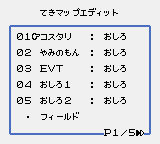
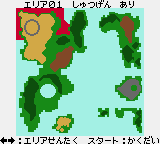
- The world map is cut into 40 areas, whose shapes belong to the world map you chose; ← → step through them, and the miniature lights the one chosen. The page says whether monsters appear there, 「しゅつげん あり」 (they do) or 「なし」 (they don't).
- Each map has a troop for each of its floors, so a tower can grow harder floor by floor; the whole floor shares it.
- The troop page has the six places 1–6, each a monster or none なし, with the monster at the cursor shown beside (its picture, HP, MP, gold and EXP), Test テスト, a battle against the troop with a test party whose levels you set (1–99, not saved), and Clear クリア.
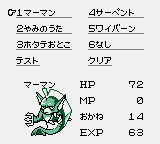
A random battle draws one to three monsters at random from the troop of where the party is. Fewer heroes meet fewer monsters: a hero alone meets at most two. The chance is the same everywhere, 17 in 256 a step, and a battle comes at the latest on the fifteenth step; there is no rate to set. The airship meets none. The draw is in How battles work.
An example: the start of NOBLE CAT#
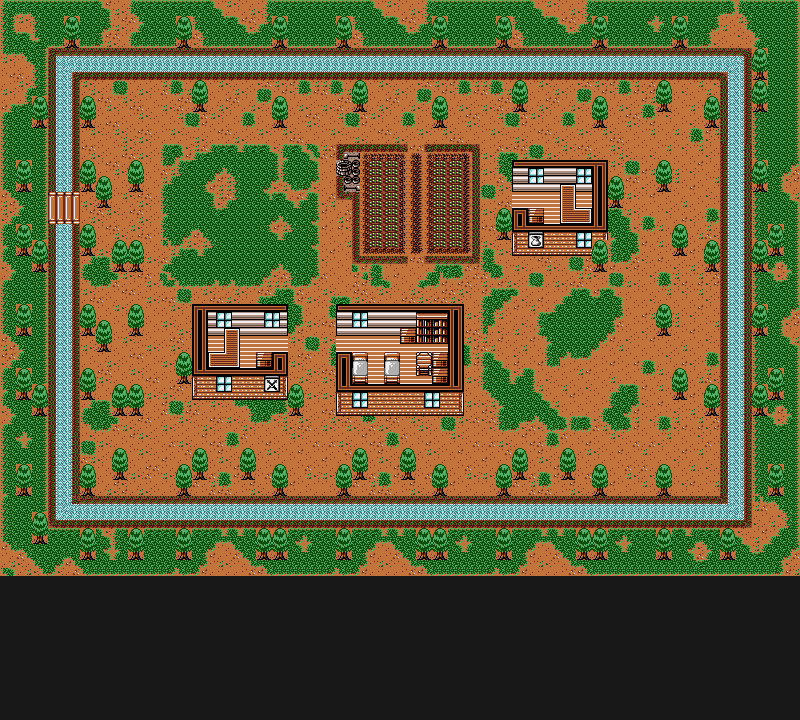
The sample begins in アロン, a village of a single floor: four rows of five rooms, the outer ones a moat and its banks, the inner ones houses, a field and woods. The player's home is one of the houses. The game's very first event stands in a room of that village: it asks the player to name the hero, then warps the party to the castle コスタリ for the opening (Events).
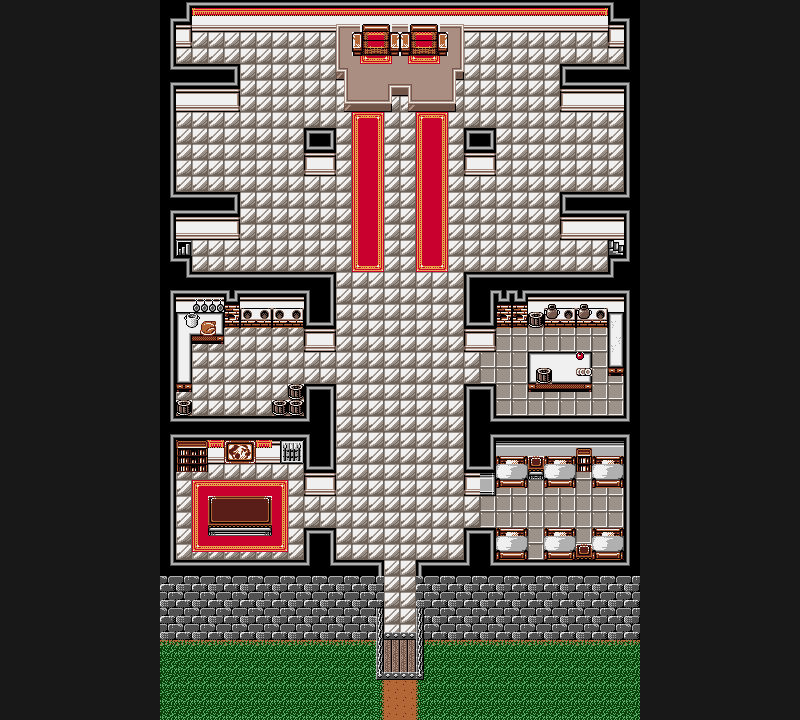
From the village the player walks out over the bridge on the west side, off the map's edge and onto the world map, beside アロン's icon. A signpost on the world map points the way: 「ひがし…ハムズ」, east to ハムズ, and south to the castle. コスタリ is a four-floor castle entered from the world map at the gate of its 1F, with the throne room at the top of that floor; its stairs climb to 2F and 3F and go down to a single column of rooms on B1, as the diagram at the top of this page shows.
The sample game NOBLE CAT follows the whole route.
Fan-made reference material, one of the Eschaton Games Tsukuru guides. Not affiliated with the publishers of the titles it covers. Corrections and questions: contact@eschaton.games.