RPG Tsukuru GB#
RPG Tsukuru GB (RPGツクールGB) is a Game Boy Color cartridge for making role-playing games without programming. ASCII published it in 2000. Kuusou Kagaku (空想科学), the developer of the Super Famicom's RPG Tsukuru titles, made it, and its logo comes up every time the cartridge is switched on. The program is in Japanese only, written in kana with no kanji. This guide explains in English how to make a game with it and how to play one, and describes how the program works inside.
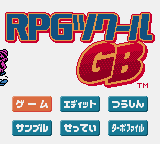 123456
- 1 Game ゲーム plays your game: its opening, then Continue or From the Start
- 2 Edit エディット the editor menu: the database, maps, messages, events and test play
- 3 Link つうしん gives or receives one part of a game over the link cable
- 4 Sample サンプル plays the sample game, NOBLE CAT, straight from the ROM
- 5 Settings せってい one setting: switch on straight into your game
- 6 Turbo File ターボファイル saves, loads or deletes the whole cartridge on a Turbo File GB
You make a game in the editors: a title, eight heroes, forty spells, a hundred and fifteen items, seventy-two monsters, twenty-five maps, the messages and the events that tell the story. Then you play it on the same cartridge. The finished game plays like a Dragon Quest of its time, on a handheld: rooms one screen each, a world map that scrolls and wraps, a command window, battles seen from the front, a ship and an airship, and an ending that rolls the program's staff with your name second. The cartridge keeps one game of your own, besides the sample game in its ROM, NOBLE CAT. A link cable sends a game to a friend's cartridge part by part, and ASCII's Turbo File GB holds thirty games on each of its two sides.
RPG Tsukuru GB came five years after RPG Tsukuru Super Dante and three after RPG Tsukuru 3, from the same team, but it is a new program: none of the older titles' code could run on the Game Boy's processor, and it shares none with them but the random number generator, constant for constant. What it shares is the design. It has Super Dante's scale and its four fixed world maps with a ship and an airship, RPG Tsukuru 2's event model and nearly all its commands, and RPG Tsukuru 3's taste for chance in battle. What 32 KiB of save could not hold it moved into the ROM: the rooms are prefabricated screens, the world maps are fixed, a spell's effect is its slot and an item's kind is its number. Compared with the titles before it has the whole comparison.
A few of those numbers need a word. You don't draw a map tile by tile: a map is a building of floors, each floor a grid of 5 × 5 or 6 × 6 rooms, and each room is one of the screens built into the ROM for that kind of map, a castle, a town, a village or a dungeon (Maps and the world). The world map is not drawn either: it is one of four in the ROM, and you place the towns and castles on it. A message is 4 lines of 16 characters, written apart from the events and shown by number. And there is no kanji anywhere in the text: besides the logo 空想科学, drawn as a picture, the only kanji the cartridge holds are on the screen an older Game Boy shows, telling the player that this is a Game Boy Color cartridge.
About this guide#
This is an original English guide, not a translation. No manual or guidebook for RPG Tsukuru GB was at hand, so it cites none. It was written from a preservation project's study of the program itself, whose reverse-engineering notes are its only source. The study read the cartridge's code and decoded every format a game is made of: the save, the text, the database, the maps and graphics, the events and their interpreter, the battle, the sound, the link cable and the Turbo File GB, and the editors' limits. It ran as fourteen packages, from the power-on check of the save to the comparison with the older titles, and its findings were checked in the Mesen emulator: the save was rebuilt byte for byte, thirty-nine battles were replayed draw for draw by a model of the rules, the sound driver was modelled write for write, and a game was sent between two linked copies of the emulator. The last package ran the save, an event and nine battles again in a second emulator, SameBoy, with no disagreement: the same save, the same screens pixel for pixel, and the same battles. Nothing was checked on a real Turbo File GB or a real link between two consoles: those were run against models of them.
Where the study read something from the code without seeing it happen, or inferred it, the guide says so ("by the code"). Where it couldn't settle a question, the guide leaves it out rather than guess. How it works describes the inside, and Behind the scenes describes the study.
Boxes like these compare RPG Tsukuru GB with the titles before it, for a reader who knows one of them:
Other boxes give tips for making games, or describe a bug and how to get round it.
The pictures and sounds#
- Screenshots were taken in SameBoy by a script, from power-on, so they can be taken again and come out the same. The cartridge's save holds no game, so the editors' screenshots show the sample game loaded with Sample Load, or saves the project's tools wrote. The colours are put through the same Game Boy Color colour adjustment Mesen uses. A few screens that need a second console or a device on the link port are the study's own shots from Mesen. Key screens have numbered labels, with an English key underneath.
- The graphics catalogue (the monsters, the characters and vehicles walking, the room tile sets, the four world maps, the title screens and the fonts) was drawn straight from the ROM by the project's tools.
- The music and sound were played by the game's own sound driver in SameBoy and recorded, numbered as the editor numbers them.
The program is Japanese only, so every screen appears as the game draws it. The text gives each label in English with the Japanese beside it the first time, for example Edit エディット. The glossary collects them all.
The chapters#
Start here#
Making a game#
Catalogue#
Reference#
What you need#
- The cartridge: RPG Tsukuru GB, CGB-A2QJ, with 2 MiB of ROM and 32 KiB of battery-backed save. It runs on a Game Boy Color only: on an older Game Boy it shows a message saying so and stops. An emulator of the Game Boy Color does as well; the study used Mesen and SameBoy.
- A second-hand cartridge's save can be lost at the first power-on. A save the program doesn't recognise is formatted at once, without a word, and a part of the save that fails its check is cleared with a message and no way to refuse. Copy the save with a cartridge reader before you switch an old cartridge on (Getting started).
- To share a game: a link cable and a second Game Boy Color with its own RPG Tsukuru GB. The game goes over in up to ten parts, one at a time (Saving and sharing).
- For more than one game: ASCII's Turbo File GB on the link port holds the whole cartridge as one file, thirty to a side. It is optional.
- No Japanese is needed to follow the guide, though the kana help when typing names.
Fan-made reference material, one of the Eschaton Games Tsukuru guides. Not affiliated with the publishers of the titles it covers. Corrections and questions: contact@eschaton.games.